
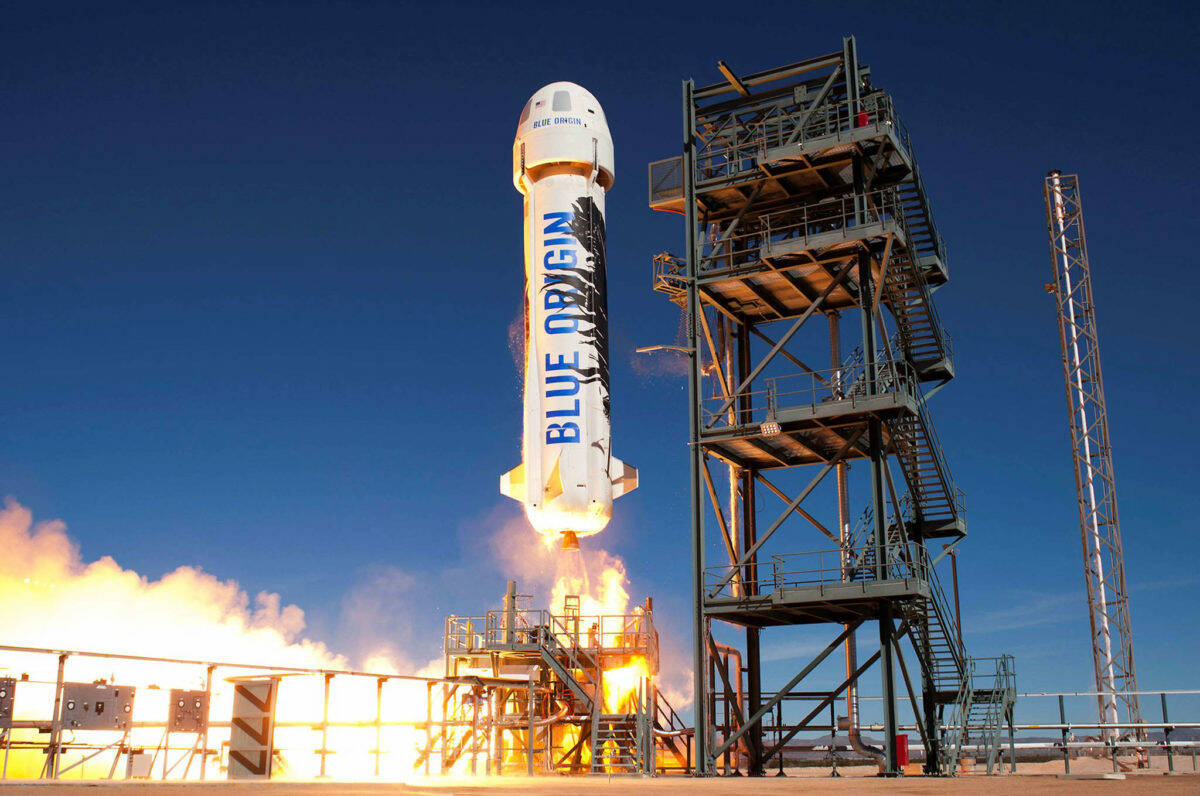
Kent-based Blue Origin has paused its New Shepard tourist flight program “for no less than two years,” according to a company statement released Jan. 30.
“Blue Origin today (Jan. 30) announced it will pause its New Shepard flights and shift resources to further accelerate development of the company’s human lunar capabilities,” according to the statement. “The decision reflects Blue Origin’s commitment to the nation’s goal of returning to the Moon and establishing a permanent, sustained lunar presence.”
New Shepard is the first reusable spaceflight system to vertically land and has flown 38 times and carried 98 humans above the Kármán line to date, according to the company. Blue Origin completed its most recent flight with six crew members on Jan. 22 from its launch site in West Texas. Five of the crew members paid for the flight and a Blue Origin employee replaced a member who was unable to make the flight.
New Shepard has launched more than 200 scientific and research payloads from students, academia, research organizations and NASA, according to Blue Origin.
“This consistent and reliable performance, combined with an exceptional customer experience, has resulted in a multi-year customer backlog,” according to the statement.
Blue Origin didn’t announce what will happen to the flights booked by people or any impact on company jobs because of the pause.
“As we enter 2026, we’re focused on continuing to deliver transformational experiences for our customers through the proven capability and reliability of New Shepard,” said Phil Joyce, New Shepard senior vice president, after the Jan. 22 flight. “We are grateful for our astronaut customers who put their trust in our team to bring this experience into reality.”
Blue Origin charges people to fly into space, but does not reveal the prices. Some people receive sponsored flights. A refundable deposit of $150,000 is required to start the process to book a flight, according to the company’s website.
Amazon founder Jeff Bezos started Blue Origin in Kent in 2000. The company manufactures and operates rocket engines, reusable launch vehicles, lunar landers and satellite systems.
NASA selected Blue Origin in 2023 for a $3.4 billion contract to develop a human landing system for the agency’s Artemis V mission to the Moon.
Under this contract, Blue Origin and its National Team partners will develop and fly both a lunar lander that can make a precision landing anywhere on the moon’s surface and a cislunar (between the Earth and the moon) transporter, according to a 2023 Blue Origin email. The partners include Lockheed Martin, Draper, Boeing, Astrobotic and Honeybee Robotics.
Blue Origin’s New Glenn rocket is planned to be used for human and cargo flights to the moon and Mars. New Glenn, which first launched in 2025, is designed to carry a lunar lander. The rocket launches from the Cape Canaveral Space Force Station in Florida.
Analysis of decision
Eric Berger, the senior space editor at Ars Technica, summarized the Blue Origin move in a Jan. 30 article.
“The decision to end New Shepard will inconvenience a few dozen very rich people waiting their turn to go into space on New Shepard, but more broadly, it is a win for the U.S. space industry,” Berger wrote. “Blue Origin has justifiably been criticized for trying to do too many things at once, resulting in all of its programs moving too slowly. Focusing on New Glenn and the lunar lander program in the near term will be a great boon for space access and the nation’s competition with China to secure the moon.”
Talk to us
Please share your story tips by emailing editor@kentreporter.com.
To share your opinion for publication, submit a letter through our website https://www.kentreporter.com/submit-letter/. Include your name, address and daytime phone number. (We’ll only publish your name and hometown.) Please keep letters to 300 words or less.
