
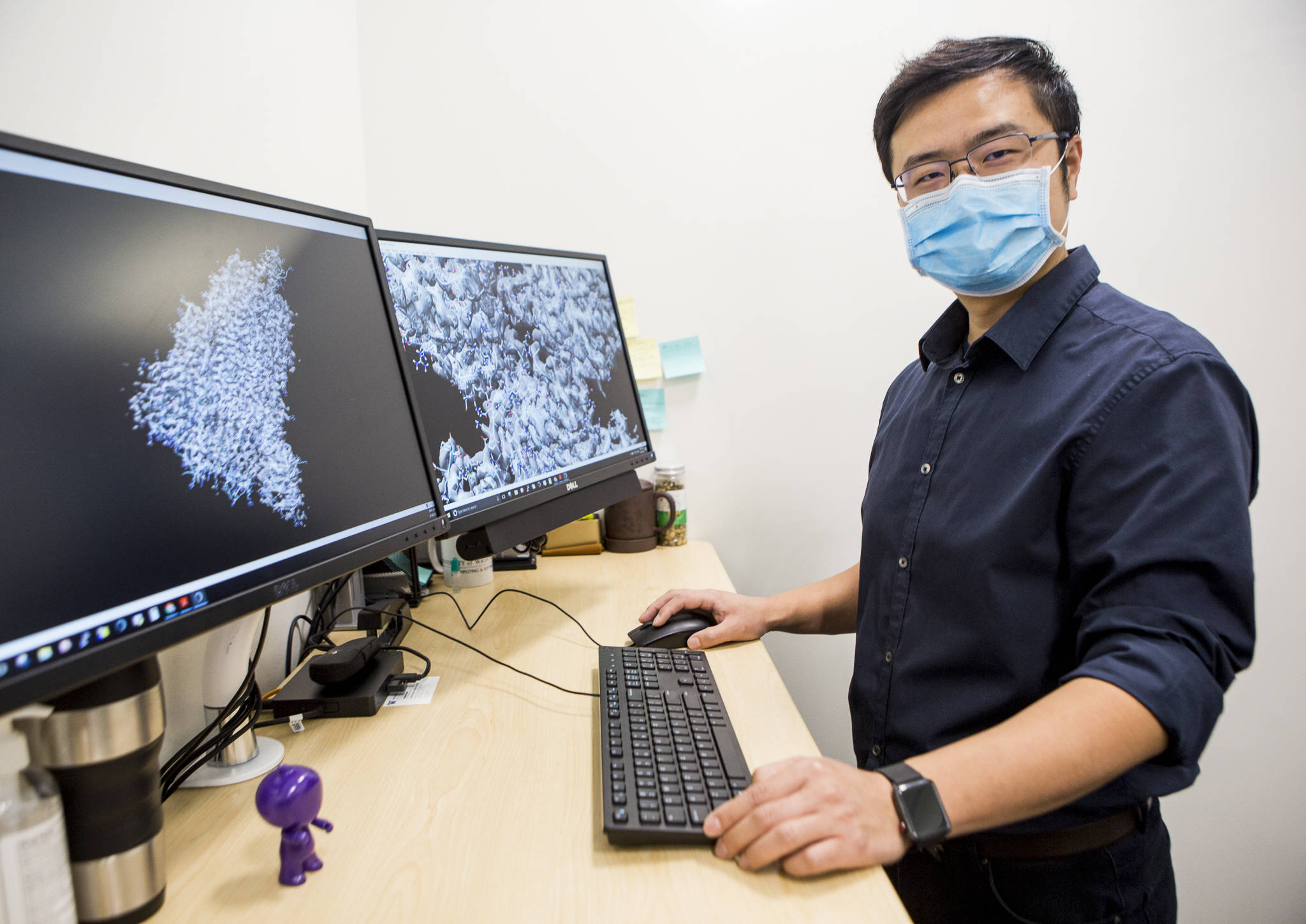
BOTHELL — For weeks now, Dong Si, who teaches computational science at the University of Washington Bothell, has been getting by on four hours of sleep.
Excitement wakes him in the still-dark hours. Two shots of espresso fuels the momentum.
Si and a team of 15 students recently launched a web server that lets researchers peer into the deepest recesses of the coronavirus.
The lens is a software program he developed called DeepTracer, which can predict what the virus is made of, down to the smallest components — molecules and atoms.
“Every day I wake up excited to work on this,” said Si. “I need to work on this every day to make it faster, better and more accurate.”
Knowing the structure of the coronavirus — how the atoms line up, so to speak — is critical to drug developers.
The information can create a more precise target for researchers seeking to disable or kill the virus.
“If you know the actual atomic structure of the viral protein, you will know how to speed up the development of vaccines or drugs,” Si said.
DeepTracer is available to anyone. Thousands have logged onto the website since it launched July 21.
The UW Bothell team is one of a handful of groups around the world using artificial intelligence — machine learning — to explore and map the coronavirus.
“Not too many people are working on this problem,” said Si, who began a project to map the coronavirus in February.
Two weeks ago, the team — mostly UW students and one Seattle-area high school student — added a button to the website that lets the program display on a smartphone.
Users can now gaze at the coronavirus when they’re sitting at the park or planted on the couch.
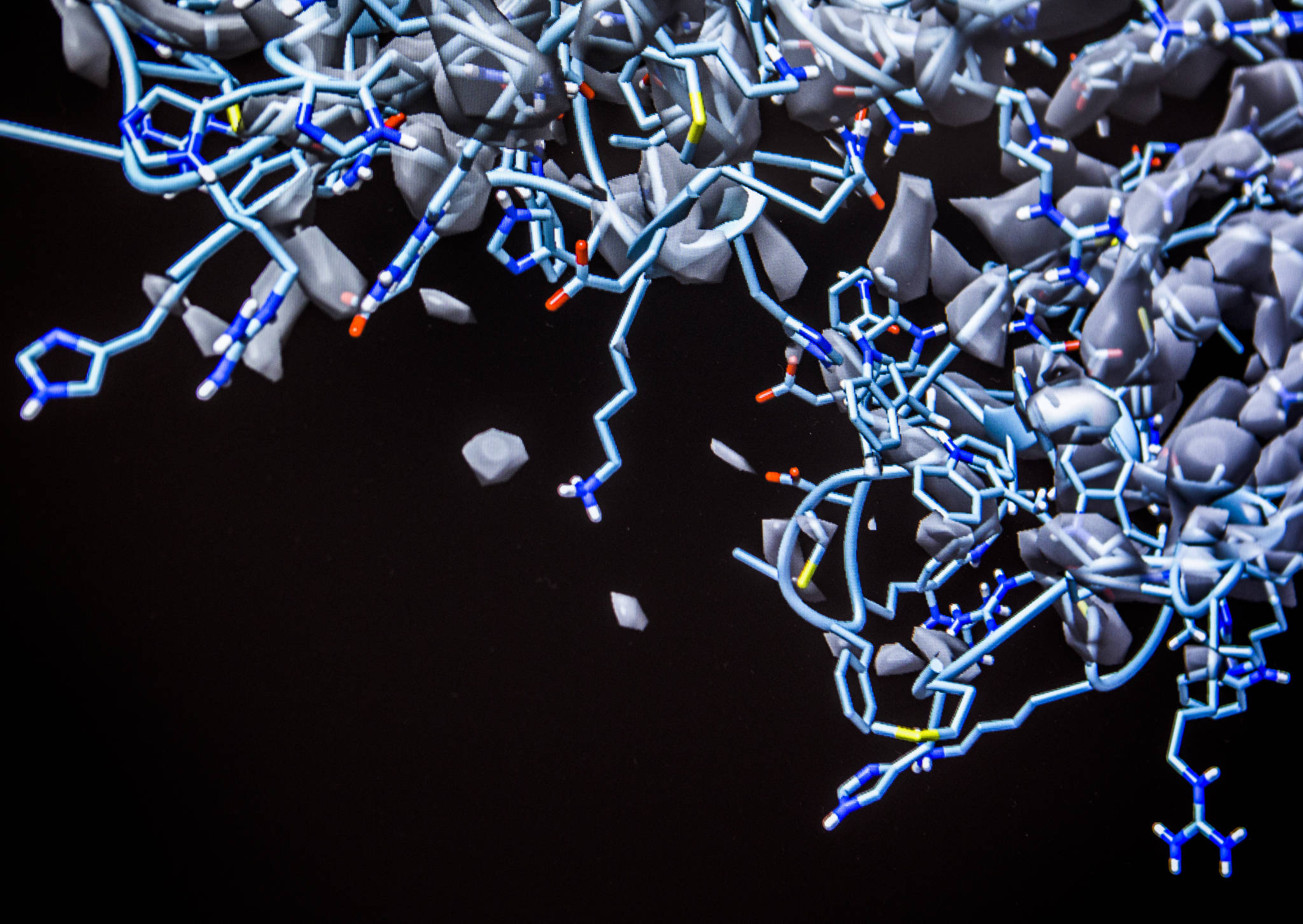
A close look at a coronavirus model created by Dong Si and his students at UW Bothell. (Olivia Vanni / The Herald)
According to independent researchers, DeepTracer’s accuracy for predicting the structure of the virus averages 84%. That’s a good day at the racetrack, but Si would like to bump that up to 99%.
DeepTracer is being used in particular to zero in on the protein spikes that jut from the surface of the virus.
A spike uses specific proteins to dupe human cell receptors into thinking it’s safe to open the door. (It’s like knowing the secret knock.)
If that occurs, the coronavirus hijacks the cell’s reproductive mechanism and the cell begins spewing copies of the virus.
Infection is the result.
Si has been working from his Woodinville home this summer, but on a recent morning he dropped into his small office at the UW Bothell campus to explain his work.
Computer programming books share the shelves with a half-dozen small, spongy balls — pink and purple models of an assortment of viruses and their spikes.
Si has been generating virtual models of viruses and their insides, including the Ebola virus, for 11 years. He admits: Biology wasn’t his strongest subject in high school. But while earning a Ph.D. in computer science, he discovered that computers could be harnessed to analyze bacteria and viruses.
DeepTracer uses 3D images of the coronavirus’s spike — taken by an electron microscope — to probe beneath the surface.
Enlarged millions of times, the spike resembles a knobby, gray cone.
While the image provides a glimpse of the spike’s surface and volume — if offers few clues to what lurks beneath.
Enter DeepTracer.
The program has been seeded with information about the structure of other viruses and macromolecules, which are large molecules composed of thousands of atoms.
Armed with a trove of existing models, maps and genetic sequences, DeepTracer’s artificial intelligence engine can predict which atoms are located where, Si said.
It’s akin to chess-playing software that uses information gleaned from millions of chess games to predict an opponent’s next move.
The resulting 3D model of the virus can resemble a structure made of Lego blocks. Specific atoms, such as oxygen and hydrogen, for example, are labeled with distinct colors so they can be easily identified.
Researchers and drug developers across the globe are “working day and night” to develop potent vaccines,” Si said.
The coronavirus isn’t the only bad bug DeepTracer is prepared to tackle, Si said.
“No matter what new bacteria or virus comes — tomorrow or next year — we will be able to model it quickly,” he said.
Janice Podsada; jpodsada@heraldnet.com; 425-339-3097; Twitter: JanicePods
Talk to us
Please share your story tips by emailing editor@kentreporter.com.
To share your opinion for publication, submit a letter through our website https://www.kentreporter.com/submit-letter/. Include your name, address and daytime phone number. (We’ll only publish your name and hometown.) Please keep letters to 300 words or less.
