
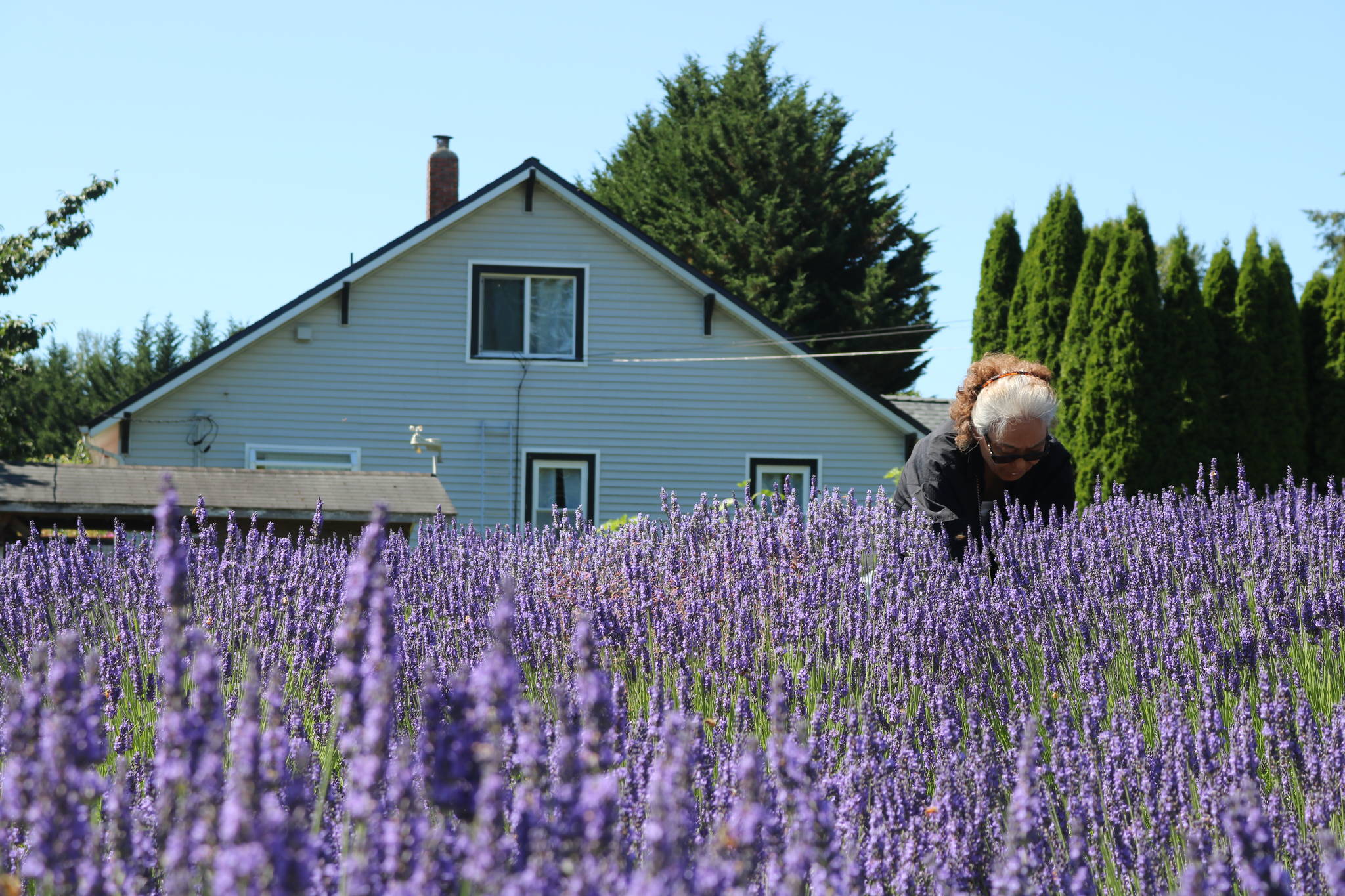
Emma Shorr has been working Snoqualmie Valley soil since 2016, first as an employee at a local farm, and now for herself as the operator of Rising Sign Farm.
The half-acre vegetable farm near Carnation produces food she sells directly to residents, and which ends up at restaurants and nonprofits in the area. Shorr signed a lease that will carry her into 2022, but beyond that, the future remains uncertain.
Shorr, like many other farmers in the Snoqualmie Valley, leases land instead of owning it. The price of farmland in the county is sky-high when compared to other areas of the state. And most farms need additional components like water rights and infrastructure to operate, which can be expensive and difficult to acquire.
The problem is magnified for farmers of color in a region where the farming industry is overwhelmingly white. The Record spoke to farmers and representatives from nonprofits and the county to figure out what’s being done to make farming more accessible in King County.
Before Shorr started her own farm, she worked at Steel Wheel Farm outside of Fall City. Last year, she signed a lease at Stuart’s Landing through the Experience Farming project run by SnoValley Tilth.
The program withdrew from the property over the last year, but the landlord let farmers negotiate to stay and farm on the land. Shorr chose to do this, and signed another lease that will carry her into next year. She hasn’t been extensively looking for farmland, but it’s a search Shorr said is a perpetual challenge in the Snoqualmie Valley.
“For me, it feels impossible that I would ever be able to own land,” Shorr said. “When I think about the longevity of farming and having a place that feels secure, I think a lot more about alternative options like having a long-term lease.”
The idea of a co-op has also been growing on her, and she’s tossing around the idea of partnering with other farmers to find land.
Ryan Lichtenegger, who owns Steel Wheel Farms where Shorr worked before starting her own operation, had been looking for land since at least 2018. His farm operates on leased land too. But since then, he’s partnered with a hay farming operation that sits adjacent to the property he leases.
Together, Lichtenegger and the neighboring farm approached his landlord and worked out a deal to farm all of the property. While the hay farm takes up the majority of the space, Steel Wheel was able to expand from 7 acres to 25 acres.
It provides enough space for the vegetables and grains he grows, along with infrastructure like wash stations and a barn.
“It changed our farm future planning, as far as not looking for other property, but being able to expand where we’re currently at,” Lichtenegger said.
He described searching for property as disappointing. In King County, there’s not much farmland, especially for smaller farms that can’t afford to buy 40 acres or more.
“The struggle is real,” he said. “Farmland is hard to come by, and the values — it’s overvalued really — because some of the prime growing land is being taken up by people who want horses, or want to just mow grass. Or it’s land that doesn’t have access to water.”
Green acres
The average price for an acre of cropland in Washington state in 2020 was $2,610, according to the U.S. Department of Agriculture.
In its latest comprehensive survey from 2017 (with the next due out in 2022), the department found that the average price for an acre of farmland in King County was more than $35,000 — by far the most expensive in the state. Pierce County came in second at $21,500 per acre, followed by Snohomish County at $19,332.
The price of land is a challenge that Anthony Reyes, farm operations lead for 21 Acres Center in Woodinville, sees as well.
“For farmers who are working with such a small income margin to begin with, it makes the purchase of land inaccessible,” Reyes said.
These challenges can be compounded for Black, Indigenous and people of color (BIPOC) farmers.
According to the USDA, farming in King County is overwhelmingly white. In its 2017 survey, it found farms with a Black or African American principal producer only accounted for 11 farms, totaling 63 acres.
Hispanic, Latino or Spanish origin farmers had only 88 farms, accounting for 1,121 acres. Farms with a principal producer of Asian descent accounted for 101 farms, and 2,441 acres. Native American or Alaskan Native farmers held 15 farms totaling 326 acres.
There are nearly 42,000 acres of farmland across King County.
Reyes is a Chicano farmer, and said several issues likely contribute to that disparity. One is a lack of transportation for many, and even being able to get out to relatively remote farmland can be a challenge. Access to capital and resources are other areas that impact BIPOC farmers.
Even being able to enter farming in the first place can be a privilege in itself — “where you can take a loss for a couple years, or you have the freedom and the space and capacity to work multiple jobs to make it work, or you’re coming from considerable wealth and capital already,” Reyes said.
King County is located on the indigenous land of the Salish peoples, and farming in the Valley also means grappling with the reality of colonization.
For Shorr, one way to begin to address this is by paying “Real Rent” to the Duwamish Tribe, which has yet to be recognized by the federal government.
Crosscut last year wrote that Seattle has a rich history of BIPOC farmers, but gentification as well as racist practices like redlining resulted in farmers losing much of the farmland they once had. Many farmers of Japanese ancestery were also placed in internment camps during World War II, and lost their land.
Historically, restricting access to land has been a tool to promote inequities, said Melissa Campbell, executive director of the Washington Farmland Trust. The nonprofit works to find and preserve farmland across the state, but especially in Puget Sound.
One way Congress is addressing this is by including $5 billion of debt relief for BIPOC farmers in the recently approved stimulus package. Black farmers have been hit hard over the last century. According to the USDA, about 14% of farmers across the country were Black in 1920. Today, the number is less than 2%.
And there’s work being done locally to make land more accessible for small farmers. King County has a local food initiative, which helps boost local agriculture. It also has farmland preservation districts, which were implemented in 1979. Currently, some 16,000 acres are classified as protected farmland in King County.
“That’s a really powerful tool that counties can adopt and utilize to protect farmland within their county borders,” Campbell said.
Michael Lufkin, local food economy manager for King County, said the county also owns five farms that are actively farmed stretching from the Sammamish Valley to South King County. This land is being used to help new or aspiring farmers lease land.
These farms come with needed infrastructure, taking the cost burden of purchasing things like wash stations or equipment away from farmers.
“We want to provide the land resource and infrastructure resources that will help launch these businesses successfully,” Lufkin said.
Nonprofits like SnoValley Tilth are also running their own similar programs such as the Experience Farming Project, said Dave Glenn, the organization’s executive director.
For Glenn, despite the challenges, preserving and expanding local farms is something that benefits Puget Sound. They create sustainable local jobs, provide fresh food and spawn an ecosystem of related services.
“There’s in my mind, 100 reasons for why we should have local farms producing local food,” Glenn said. “There’s a question of value to the community that I think is really important for us to think about as a region.”
Talk to us
Please share your story tips by emailing editor@kentreporter.com.
To share your opinion for publication, submit a letter through our website https://www.kentreporter.com/submit-letter/. Include your name, address and daytime phone number. (We’ll only publish your name and hometown.) Please keep letters to 300 words or less.
