
WASHINGTON, D.C. — U.S. Supreme Court justices wrangled May 13 with whether states can penalize presidential electors who vote their conscience rather than party, and the potential political consequences if they cannot.
They heard arguments in a case of three Washington state residents who went rogue in 2016 by breaking their pledge to cast their Electoral College votes for Democratic candidate Hillary Clinton, who won the state’s popular vote.
The trio contend electors can, under the Constitution, back the candidate of their choice. But the Secretary of State ruled otherwise and fined each $1,000. Washington’s Supreme Court upheld the fines in 2019.
“Do the states have the power to control through law how an elector may vote? They do not,” said Lawrence Lessig, attorney for the three electors. “The states get to appoint, no doubt, but they appoint electors who are then privileged to cast their votes without regulation by the state.”
It’s not an “unfettered discretion” as attorneys for the state have argued, he said. It is “a completely fettered discretion, just fettered by moral and political obligations, not by legal constraint.”
Justices wrestled throughout the hearing — and a subsequent one regarding punishment of three faithless electors in Colorado — with the breadth of electors’ discretion and states’ enforcement powers under the constitutionally established process of selecting a president.
“It’s somewhat hard to understand the concept of something I am pledged, bound to do, I have made a promise to do something, but that promise is unenforceable,” said Justice Ruth Bader Ginsburg.
To which Lessig responded: “A pledge is always and only a moral obligation.”
At times, justices sounded vexed at Lessig’s argument that electors could not be removed for something as serious as accepting a bribe or acting on behalf of a foreign government unless such allegations lead to charges and conviction before the Electoral College convened.
And several justices raised a concern of states and political parties — that allowing every presidential elector limitless freedom would sow chaos.
If the popular vote is close, and changing a few electoral votes could alter the outcome, “the rational response of the losing political party … would be to launch a massive campaign to try to influence electors, and there would be a long period of uncertainty about who the next President was going to be,” said Justice Samuel Alito. “Do you deny that that is a — a good possibility?”
A possibility, yes, Lessig said. “We deny that it is a good possibility.”
Later, in response to a question from Justice Brett Kavanaugh, he said, “you might worry that there’s an increased risk of ‘chaos’ if electors have the discretion we believe they’ve always had.”
That likelihood is tiny “given it requires electors who are the loyal of the loyal to band together in dozens or, you know, three dozen in the last election and flip sides. And, of course, the likelihood of that is extremely small.”
If justices side with the faithless electors, it could inject a degree of havoc and uncertainty when the Electoral College convenes in December to formally select the next president. And it could energize a movement that wants to require that U.S. presidents be elected based on results of the popular vote nationally, not ballots cast by members of the Electoral College.
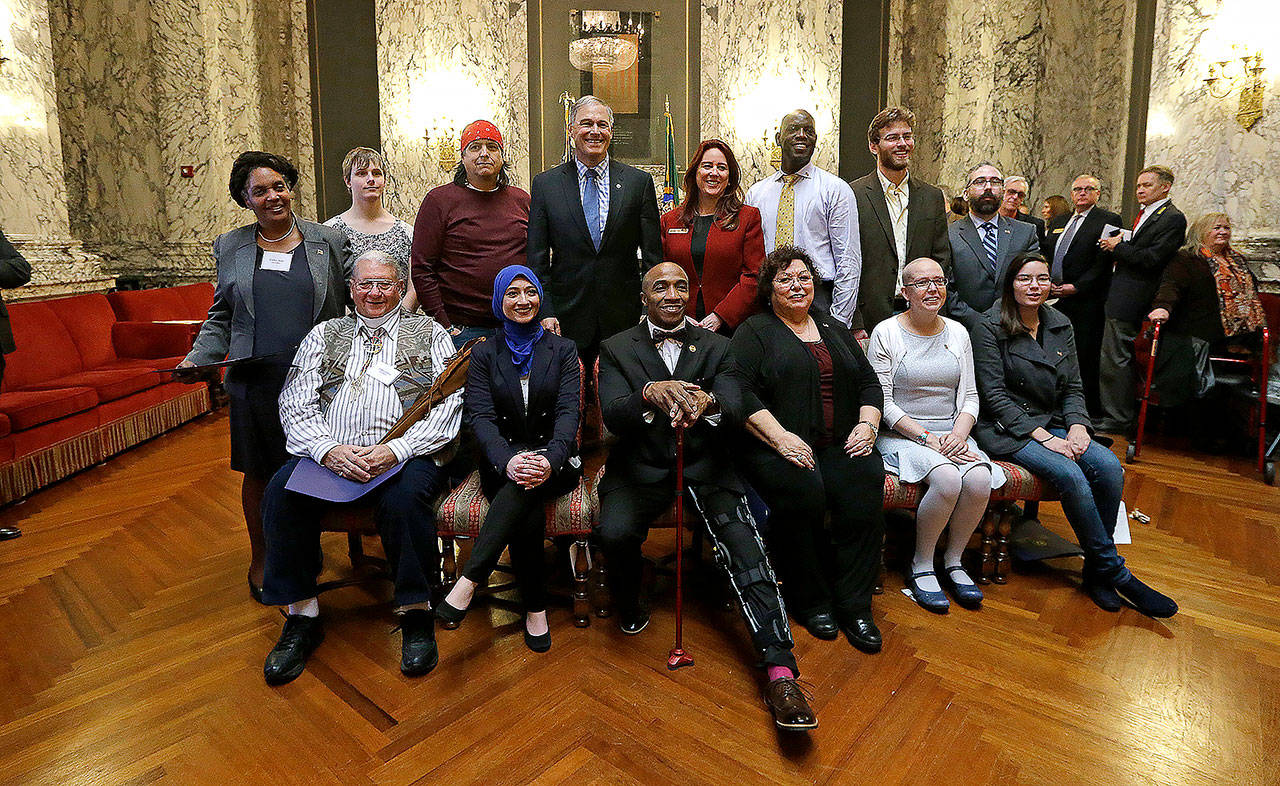
Bret Chiafalo of Everett, Levi Guerra of Warden and Esther John of Seattle signed pledges to cast their votes for the party’s nominee, Clinton, if she won the popular vote in Washington, which she did. In Washington, Clinton received about 521,000 more votes than Donald Trump. Nationally, she received about 2.8 million more votes.
Solicitor General Noah Purcell, representing the state of Washington, argued that the Constitution gives states the power to appoint electors and enforce conditions for that appointment with sanctions like a fine or removal. It’s not that electors cannot have discretion, he argued. Rather, states set the parameters.
He called “absurd” the argument a state could not remove an elector even if it knew they had accepted a bribe, unless the criminal process had been completed. And he dismissed Lessig’s contention that framers of the Constitution envisioned electors acting as free agents as “academic theory.”
Justice Elena Kagan pushed back on Purcell’s argument that the state’s power to appoint also conveys authority to remove.
“What your argument is, is that the Constitution doesn’t say and … if the Constitution doesn’t say, we should presume that states were meant to decide?” she said.
A ruling is expected by the end of the court’s term in early summer.
Talk to us
Please share your story tips by emailing editor@kentreporter.com.
To share your opinion for publication, submit a letter through our website https://www.kentreporter.com/submit-letter/. Include your name, address and daytime phone number. (We’ll only publish your name and hometown.) Please keep letters to 300 words or less.
