
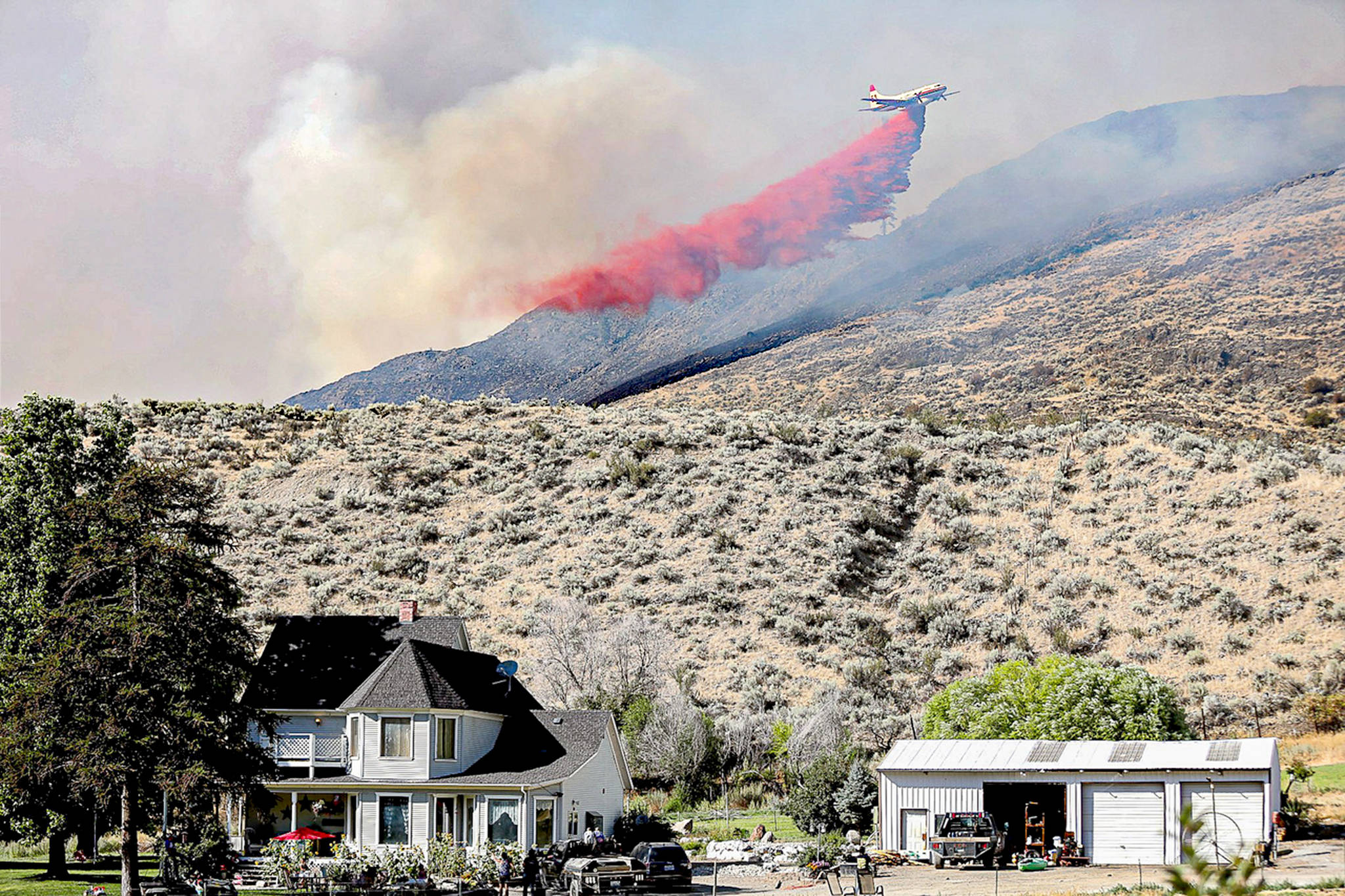
The ferocity with which the fires of Sept. 7 swept across Washington state is nearly unmatched.
In a single day, some 300,000 acres were incinerated. The small town of Malden was all but wiped from the map, and other communities across central and eastern Washington were placed under evacuation notices. Thick smoke blanketed much of Puget Sound, forcing people indoors to escape the choking air.
And despite well-laid plans by the Washington state Department of Natural Resources — tasked with the difficult job of planning for a fire season in the midst of a pandemic — a strong east wind grounded critical fire fighting aircraft for much of the day on Sept. 7.
The fires illustrate the dangers of how climate change acts as a threat multiplier. In Washington state and the West Coast, a hot, dry summer has primed grasses and trees to easily catch fire.
During a normal year, this can make firefighting difficult. And during a summer marked by a pandemic and a strong windstorm, fires have exploded.
Crucial aircraft grounded
“What we saw over the course of the past 24 hours, as far as an individual day, is almost unprecedented,” Thomas Kyle-Milward, Washington state Department of Natural Resources spokesperson, said on Sept. 8.
Between 2009 and 2018, the average number of acres burned each year across the state was about 320,000. The fires sparked on Sept. 7 burned nearly that much in a single day. Until that day, the fire season had been relatively subdued, and even with the outbreak, the total acreage burned is still less than the devastating fires of 2015.
Fifty-eight fires, including nine large ones, raged across the state on Sept. 8. These fires are concentrated in central Washington.
In recent years, as firefighting agencies across the West scrambled to control wildfires, aircraft have been in high demand.
The state Department of Natural Resources has 10 Huey helicopters it uses for fire suppression. The helicopters played an even more important role this year amid the coronavirus pandemic.
The department has tried to thin the number of firefighters on the line to reduce the risk of the virus spreading among fire crews. Aircraft have been used to aggressively knock down fires and keep firefighters safe.
But on Sept. 7, east winds with gusts up to 70 mph grounded aircraft in the afternoon.
“If we can’t get our resources in the air, it definitely impacts the effectiveness of our fire suppression response,” Kyle-Milward said.
The department anticipated more fires than usual to start over the weekend, with the forecasted windstorm, and people flocking to the woods for a three-day Labor Day weekend.
They encouraged people to be careful and avoid starting fires, but even still, Department of Natural Resources Commissioner Hilary Franz said in a tweet at least 90 percent of the fires started over the weekend were man-made.
Strong winds
Generally in September, winds blow in from the Pacific Ocean, traveling across Puget Sound and the Cascades, said Matthew Cullen, meteorologist with the Seattle branch of the National Weather Service.
A high pressure system brought the opposite over the weekend and Sept. 7. Hot, dry winds swept east across the state. Fire fuel had been dried by late summer heat and a lack of rain.
“It doesn’t take much when the fuels are ready and the winds are strong,” Cullen said.
Winds were expected to taper off in the days following Sept. 7, giving firefighters a chance to use aircraft again.
It’s not clear how winds are affected by climate change, said Crystal Raymond, climate scientist with the University of Washington’s Climate Impacts Group. The group is starting a two-year research project to model how wind is impacted by climate change.
Hot, dry summers have been increasing in recent years, and this year the high temperatures are sticking around longer. Temperatures in some areas of Washington state reached nearly 100 degrees over the weekend of Sept. 5.
“What really stands out is that we’re seeing this in the beginning of September. That’s not really unusual, it’s just it would be more typical for our temperatures to move down heading into September,” Raymond said. “This is the type of pattern that we would expect to be more common with climate change.”
Climate change is making summers drier and hotter with less frequent rainfall in Puget Sound.
On top of less frequent precipitation, it’s stressing trees, making them more vulnerable to disease and pests. This in turn makes them better fuel for fires.
And all this is continuing on top of a pandemic, said Caleb Heeringa, spokesperson for the Sierra Club’s Pacific Northwest chapter. He noted the smoke pollution too, which has made air in much of Puget Sound unhealthy for people to breathe.
“This really drives home the connections between the climate crisis and public health, which is something we’ve known for quite a while,” he said. “This is kind of just a reminder to all of us that the climate crisis isn’t going to wait. The climate crisis doesn’t stop just because we have another crisis to deal with.”
Talk to us
Please share your story tips by emailing editor@kentreporter.com.
To share your opinion for publication, submit a letter through our website https://www.kentreporter.com/submit-letter/. Include your name, address and daytime phone number. (We’ll only publish your name and hometown.) Please keep letters to 300 words or less.
