
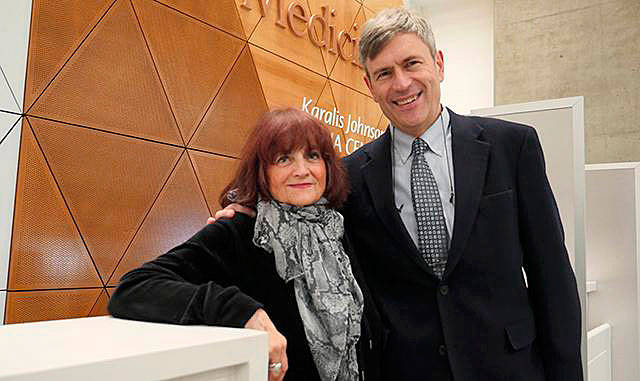
Angie Karalis Johnson has a dream that a cure for the progressive eye disease known as age-related macular degeneration will one day happen because of research advances at UW Medicine. To help realize this dream, Karalis Johnson has made a significant donation to the UW Medicine Eye Institute to establish the new Karalis Johnson Retina Center.
The Karalis Johnson Retina Center opened Wednesday at UW Medicine’s South Lake Union campus, according to a UW Medicine news release. It will occupy 5,000-plus square feet as part of a new research and clinical building on the corner of Republican Street and Dexter Avenue in Seattle.
“The opening of the Karalis Johnson Retina Center will be a major resource for the region in terms of research and clinical care of retinal disease,” said Dr. Russell N. Van Gelder, chair of the Department of Ophthalmology at the University of Washington School of Medicine, and director of the UW Medicine Eye Institute.
“The Karalis Johnson Retina Center will help us reach more patients to provide new treatments, slow degenerative conditions and ultimately restore vision,” he said.
It will be the first facility focused on clinical research for retinal vision loss in the five-state region of Washington, Wyoming, Alaska, Montana and Idaho. Patients with retinal diseases will have the opportunity to participate in clinical research, giving them access to the latest clinical trials.
Currently, providers at the UW Medicine Eye Institute see 220 to 230 patients a day and perform 10 to 15 surgeries daily. The UW Medicine Department of Ophthalmology already is among the top ophthalmology departments nationwide. Research faculty work in areas few other ophthalmologists tackle, including stem cell research to recreate eye diseases in a dish, advanced optics to get more information at a cellular scale to help doctors diagnose diseases at much earlier stages, analysis of huge amounts of data to understand disease patterns, and studies to advance gene therapy for ocular diseases. They provide care for patients with conditions such as advanced macular degeneration, diabetic retinopathy, hereditary retinal degeneration and uveitis.
For Karalis Johnson, her gift follows her life’s dream to help people with vision disorders.
She is the widow of Dr. Roger H. Johnson, a clinical professor of ophthalmology at the University of Washington School of Medicine, and a well-known ophthalmologist who ran a practice that was the primary referral center for Seattle Children’s and for eye diseases in the Pacific Northwest. She was the office manager at her husband’s practice and was touched deeply by seeing patients, often older people with macular degeneration, whose quality of life was drastically reduced by their vision problems.
Her gift is for an undisclosed amount and will be used to purchase state-of-the-art equipment as well as support research in improving advanced imaging; using big data approaches to retinal disease; accelerating the therapeutic pipeline; and advancing vision restoration techniques.
“Angie is an incredibly generous person, with a great vision for a future free of blindness from retinal disease. Her gift is transformative,” said Van Gelder. “I anticipate many advances in the care of retinal disease will be made possible from her remarkable gift.”
In 1982, Dr. Roger Johnson and Angie Karalis Johnson endowed the Roger Johnson Lectureship at Seattle Children’s Hospital, which continues to bring top pediatric ophthalmologists to Seattle to lecture each year. In 2001, they also endowed the Roger H. Johnson Award for Macular Degeneration, a cash prize that is presented annually to the scientist who has made the most significant contribution to the understanding and treatment of age-related macular degeneration.
Macular-degeneration happens when the light-sensing cells in the eye stop working and eventually die. Age-related macular degeneration is the leading cause of visual impairment for people over 60. Approximately 2 million new cases are diagnosed annually.
Karalis Johnson said she will never give up her fight to find a cure for macular degeneration.
“Until it’s cured, I won’t rest,” she said.
Talk to us
Please share your story tips by emailing editor@kentreporter.com.
To share your opinion for publication, submit a letter through our website https://www.kentreporter.com/submit-letter/. Include your name, address and daytime phone number. (We’ll only publish your name and hometown.) Please keep letters to 300 words or less.
