
There’s a good chance marijuana will be in front of voters again this fall.
This time, though, the decision will be whether to keep the industry out, not whether to let it in.
A bill passed by the state House on April 10 would erase bans on marijuana businesses that have been locally enacted by elected officials in Kent, Pacific and 56 other cities, plus a handful of counties.
But the bill would allow voters a chance to impose a prohibition on marijuana growers, processors or retailers through passage of a local ballot measure – even in a city or county where the budding weed industry is blossoming.
House Bill 2136, a 54-page rewrite of the rules and taxation of recreational marijuana commerce, passed on a strong bipartisan vote of 67-28. It is now in the Senate for consideration.
The sliver of the bill dealing with preemption and public votes tries to cope with a sizable rebellion of communities after approval of Initiative 502 in 2012.
Fifty-nine of the state’s 281 cities bar entrepreneurs from setting up shop, according to the Municipal Research and Services Center of Washington, a nonprofit that tracks policies and practices of local governments.
Four counties – Pierce, Yakima, Walla Walla and Clark – also ban marijuana businesses in unincorporated areas.
And another 50-plus cities and counties have moratoriums limiting the industry in some fashion.
State lawmakers began the 2015 legislative session determined to address the rejection of marijuana businesses. Many lawmakers did not support Initiative 502 but now want to ensure that those getting into the business are not prevented from doing so.
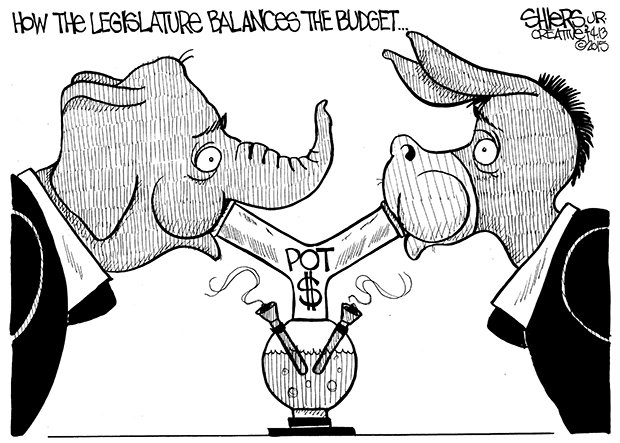
Plus, this is a potential money-maker for the state. Because of that, there’s general agreement in the House and Senate that the state should share a small piece of marijuana tax revenue with cities and counties – but only if they allow approved marijuana businesses in their jurisdictions.
They hope such a financial incentive will encourage communities to drop their bans. But House members didn’t feel that would be enough to change behavior, so in HB 2136 they wipe out the bans and moratoriums and offer two paths to re-impose them via the ballot.
Under one scenario, a voter can submit a petition signed by at least 30 percent of the registered voters of a community to the elected leaders of that city or county. The other is for members of a city council, or county council, to put it on the ballot.
A simple majority is required to pass it. And a voter-approved ban cannot be altered or repealed for two years under the House bill.
These elements of preemption and voting face an uncertain future in the Senate. Senators left them out of a similar bill they considered earlier in the session.
Should they emerge, it could create some interesting ballot dynamics.
One might expect leaders of cities with bans to try to preserve them. That could force this year’s candidates for city and county offices, including county executive, to choose sides, knowing their decision could enrage enough voters to hurt them in an election.
On Monday, the Legislature added another twist. A bill passed by the Senate and heading to the governor brings the medical marijuana industry under the regulatory structure of the recreational market.
Soon, hundreds of dispensaries will have to abide the rules of the province where they operate. If it’s a city whose leaders and voters want to impose a ban via the ballot, those dispensing marijuana might need to respond with a campaign or be prepared to relocate.
Then there are situations where residents frustrated by the presence of dispensaries in their neighborhood might try their hand at limiting or outlawing dispensaries via a ballot measure.
So there’s great potential for not just one big battle over marijuana in Washington this fall but many small ones in communities throughout the state.
Political reporter Jerry Cornfield’s blog, The Petri Dish, is at www.heraldnet.com. Contact him at 360-352-8623; jcornfield@heraldnet.com and on Twitter at @dospueblos.
Talk to us
Please share your story tips by emailing editor@kentreporter.com.
To share your opinion for publication, submit a letter through our website https://www.kentreporter.com/submit-letter/. Include your name, address and daytime phone number. (We’ll only publish your name and hometown.) Please keep letters to 300 words or less.
