
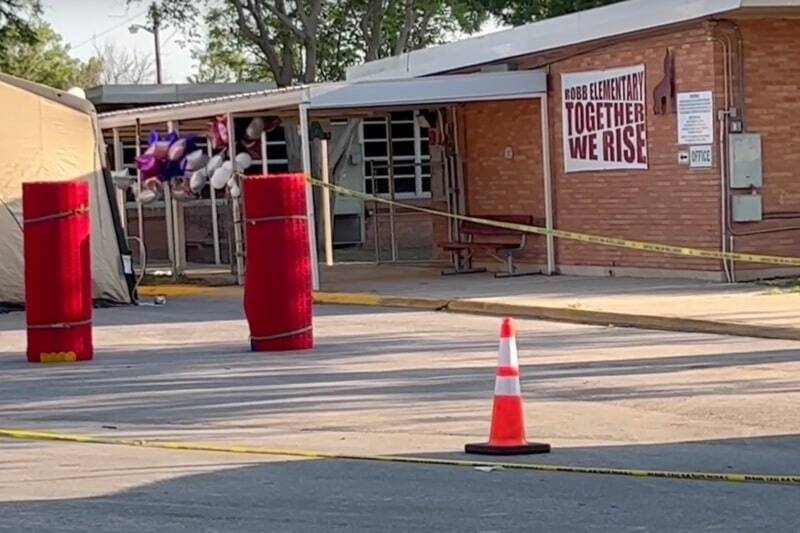
Late last month, a small Texas city joined an ever-expanding list of cities and sites that none of them ever wanted to be on.
Formerly ordinary American schools, theaters and shopping centers with ordinary American names now linked in an instant with the carnage that happened there.
Sandy Hook Elementary in Newtown, Conn., Columbine High School in Colorado, Tops Friendly Market in Buffalo, New York, to name a few. And as of May 24, 2022, Robb Elementary School in Uvalde, Texas.
Why does it keep happening? What compels one human being to pick up a weapon — here a gun — and snuff out the lives of innocents, now little kids whose eyes have barely opened on this world? To cut short the promise in their eyes?
Evil? Insanity?
Like you, I haven’t got any final answers. The problem is complex. And any attempt at dealing with the problem must itself be multifaceted.
Guns have always been part of our culture, and being so integral to our history as Americans, it is not possible that any single measure or policy will solve the current issue. As we will not cut into the violence by eliminating gun ownership, neither will we accomplish it by sinking the United States under the weight of billions of weapons.
With each of these shooting flareups, I find myself returning to what the late Robert F. Kennedy had to say in the address he gave in Cleveland, Ohio, on April 5, 1968, the morning after the murder of Martin Luther King Jr. in Memphis, Tenn.
“I have taken this opportunity to speak to you about the mindless menace of violence in America which again stains our land and every one of our lives,” Kennedy began. “It is not the concern of any one race; the victims are black and white, rich and poor, young and old, famous and unknown. They are, most important of all, human beings whom other human beings loved and needed.
“No one, no matter where he lives or what he does, can be certain whom next will suffer from some senseless act of bloodshed. And yet it goes on, and on, and on in this country of ours,” Kennedy said, later noting that “nothing short of a cleansing of our whole society can remove this sickness from our souls.”
The irony is that two months later, Kennedy would be shot to death in a kitchen service corridor of the Ambassador Hotel in Los Angeles.
Although neither RFK’s death nor the death of King nor the death by gunshot of President John F. Kennedy five years earlier were mass shootings, the problem is still the issue.
Unfortunately, as is the case with so many other of our pressing national issues, today we Americans stare balefully at each other across an ever-widening gulf of suspicion, disdain and rancor, and nothing gets done.
Yet, I remain hopeful of this thing: all people of good conscience want it to stop.
As I see it, the first step to any meaningful change is for us as Americans to again find our ability to talk with each other — fellow countrymen engaged in a common cause. I am hopeful that if we can get to that point, something positive can come of this.
We Americans must stop looking at compromise as a dirty word — it is the genius our nation was established on. Our whole system of government is based on it. Yet I hear too often the tired comment that “the only thing in the middle of the road is a yellow stripe.”
Both sides of the debate will have to give something.
The Heller decision in 2008, at first limited in scope to Washington, D.C., and later extended to the entire nation by a federal judge, established the constitutional right of individual Americans to own guns apart from service in a state militia. It established that the government may not disarm citizens in their homes.
The author of the opinion, Justice Antonin Scalia, wrote in the closing passage of Heller that the court found handgun violence in the nation was a serious issue, and that it took seriously the issues raised by concerned people who called for the elimination of handgun ownership as a solution.
“The Constitution leaves the District of Columbia a variety of tools for combating that problem, including some measures regulating handguns. But the enshrinement of constitutional rights necessarily takes certain policy choices off the table,” Scalia wrote.
But the court, Scalia continued, recognized “presumptively lawful” regulations such as “laws imposing conditions and qualifications on the commercial sale of arms,” bans on carrying weapons in sensitive places like schools, referred with approval to the “historical tradition of prohibiting the carrying of dangerous and unusual weapons,” and recognized the profound public interest in “prohibitions on the possession of firearms by felons and the mentally ill.”
I think we can find common cause there.
After all, every one of us has skin in the game. And for far too many, it’s their children’s skin.
Robert Whale can be reached at rwhale@soundpublishing.com.
Talk to us
Please share your story tips by emailing editor@kentreporter.com.
To share your opinion for publication, submit a letter through our website https://www.kentreporter.com/submit-letter/. Include your name, address and daytime phone number. (We’ll only publish your name and hometown.) Please keep letters to 300 words or less.
Robert Whale can be reached at rwhale@soundpublishing.com.
