
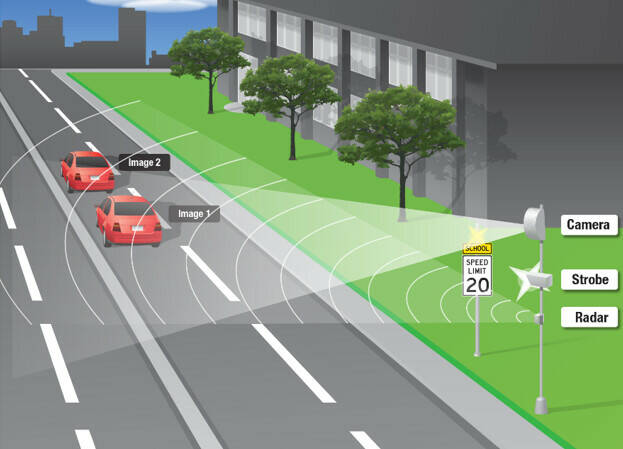
New traffic safety cameras opened watchful eyes on speeding drivers in Auburn on Jan. 12, beginning a warning period that ends on Feb. 11.
Auburn police will begin ticketing drivers for real on Feb. 12, but in the meantime, the APD will issue warning notices.
The idea is to restrict speeding in specific new general speed zones to improve safety in those areas.
The cameras are at:
• Auburn Way South on State Route 164 between the R Street SE bridge and Muckleshoot Plaza for eastbound traffic.
• 15th Street NW between M Street NW and Ron Crockett Drive for eastbound traffic.
• A Street SE between 17th Street SE and 21st Street SE for southbound traffic.
In 2024, the Washington state Legislature passed House Bill 2384, updating rules related to automated traffic safety cameras. The changes removed the limitations for agencies like the City of Auburn from only using automated traffic safety cameras in school zones, at railroad crossings and signalized intersections.
On July 21, 2025, the city approved the initial expansion of its automated traffic safety camera program beyond school zones to provide general speed enforcement, and to update the Auburn city code to square it with the recently adopted state law.
“I think this will be something that benefits the city and allows our police officers to be focused on bigger things,” Auburn City Councilmember Tracy Taylor said then.
The city took the step to meet a goal dating to 2004 to reduce the number of serious injuries and fatal crashes to 30% by 2040, and eventually eliminate them altogether on Auburn’s streets.
There are no limits to how many speed enforcement cameras agencies may operate in these areas. In the future, according to the revised regulations, Auburn may operate one additional camera per each 10,000 members of its population, which sums up to nine more, based on the city’s estimated population of 90,000 by 2040.
Here are some of the criteria the city used to determine where the cameras should go:
• Conditions making enforcement by traffic police officers difficult (limited space along corridor, high speeds, high volumes, multiple lanes).
• History of crashes and speeding complaints.
• Lack of other safety counter measures (lighting, sidewalks, and/or enhanced crossings).
• Other evaluation criteria included the posted speed limit, number of lanes, average daily traffic volume, and the roadway classification.
Talk to us
Please share your story tips by emailing editor@kentreporter.com.
To share your opinion for publication, submit a letter through our website https://www.kentreporter.com/submit-letter/. Include your name, address and daytime phone number. (We’ll only publish your name and hometown.) Please keep letters to 300 words or less.
