
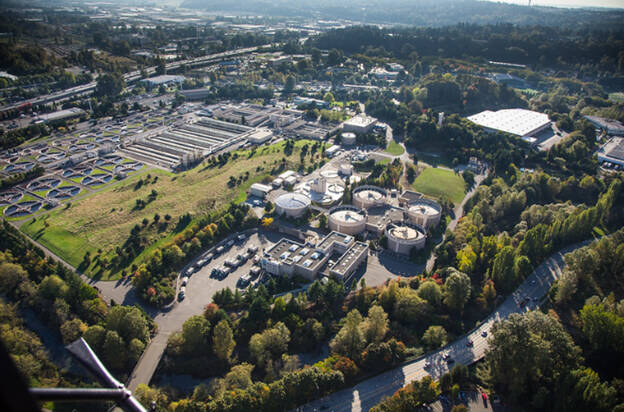
Summer droughts, a growing population and growing businesses have prompted city officials to consider repurposing Renton’s water.
Renton has partnered with King County to conduct a water feasibility study that tests whether using reclaimed water is realistic in Renton. The goal is to delay the need for purchasing water from Seattle Public Utilities and preserve Renton’s potable water supply, which refers to water that is safe to drink.
Renton and King County will each contribute $100,000 toward the $200,000 a study, in which a consultant hired by the city will survey potential customers to understand their needs, interests, and knowledge of reclaimed water and its possible uses. This survey will be in the Renton Valley, outside of the aquifer protection area.
“The state calls it reclaimed water, but most other places call it recycled water,” said Ron Straka, Renton’s utility system director. “So, it’s wastewater that comes into the treatment plant, and then they treat it to a higher level than they normally treat the wastewater to call it class A water. Reclaimed water isn’t potable, but it’s cleaner than wastewater that gets discharged out in the Puget Sound.”
King County’s South Treatment Plant is in Renton and already produces reclaimed water, but it is not distributed in Renton. Straka said this study is a way to determine whether it will be financially sound to provide reclaimed water to people in Renton. The people who would receive reclaimed water are commercial and industrial buildings that would use it for irrigation and other uses because reclaimed water is not meant for consumption.
Straka said getting reclaimed water to existing homes would not be something they would do because there is the worry of the reclaimed water crossing over with the potable water pipes — mainly because homeowners often work on their own plumbing — so they could accidentally reroute reclaimed water to a drinking water faucet. Straka said it would be possible if a new apartment complex were built, reclaimed water could be hooked up for washing machines or other nondrinking utilization, but it would be difficult to get reclaimed water to an existing apartment complex.
Straka said it wouldn’t make sense to invest in producing reclaimed water for Renton if there would not be enough customers who want to use it. Additionally, he said examining what infrastructure would be needed to actually pump the water to customers is also a big part of this study because the infrastructure could be very expensive. Straka said there are some state and federal grants that assist with reclaimed water infrastructure, but they want to ensure that building infrastructure doesn’t impact current ratepayers.
“You want to make sure you’re going to be able to construct it and, over time, get it paid back through the sale of the reclaimed water. So that’s part of what we’re going to look at: the cost, the revenue potential, and trying to see if it’s viable so that we can provide this as a way of saving the water we currently have rights to in our aquifer for potable uses,” Straka said. “So if we can get basically another source of water to meet some of the water demand we have for the nonpotable uses, that saves the water that we currently have.”
Pushing off water rights limitations
Straka said as part of the city’s water utility projection plan, they have to show that Renton has a 20-year and future water supply as demands grow with a higher population and new development.
In about 2039 or 2040, projections show that Renton will begin to push up against what its water rights are, especially during peak demand periods, which are typically in the summer. Straka said Renton gets all its water from an aquifer, and the city only have rights to a certain amount of water from it. So, even before they surpass their rights and begin to come close to exceeding them, the city will need to purchase potable water from Seattle Public Utilities.
“When it’s real hot, the demand goes up quite a bit. Most of that’s because of irrigation for lawns and landscaping,” Straka said. “So if we could use the reclaimed water to water lawns and landscaping areas, that will help us from exceeding or bumping up against our water rights.”
Straka said there’s no current estimate of how many years that 2039 or 2040 date can be pushed off if reclaimed water is utilized. He said first, they need to see how much reclaimed water they will provide.
For regular consumption use, Straka said things are fine, but it’s more about businesses that are irrigating and utilizing water for other uses that are bound to push against Renton’s water rights.
Reclaimed water
Businesses use reclaimed water for various purposes, such as irrigation, turf, food crops, cooling systems, street sweeping, soil compaction, and decorative water fountains, said Kristina Westbrook, the county’s recycled water program lead. Westbrook said some businesses want reclaimed water because it has nitrogen in it, which helps things grow. She said they’ve found that most of their customers who use reclaimed water for irrigation can either eliminate or drastically reduce their synthetic fertilizer use.
Westbrook said another significant reason some businesses want reclaimed water is the sustainability aspect of using it. She said reclaimed water is recycled, repurposing already utilized water instead of pulling potable water from the Renton aquifer.
“Some businesses have sustainability initiatives where they’re trying to reduce their use of potable water, whether it’s through conservation or finding other resources like recycled water. So that may be of interest to some of the businesses as well,” Westbrook said. “In fact, that’s really quite common with a lot of industries in California that we’ve seen there as well. I would say that’s one of the primary drivers from the irrigation standpoint. Again, the benefit that when you’re getting the water, you’re also getting the fertilizer element, that’s a huge benefit for people.”
In addition to benefiting customers, Westbrook said she really appreciates Renton’s decision to partner with King County on the water feasibility study. She said reclaimed water is a great drought-proof resource because people always send water to their sewers. Westbrook said reclaimed water can help extend water supplies in cities experiencing droughts that will only intensify with climate change.
“We think this water is great to use, and this is a great way to use it beneficially,” Westbrook said. “And so long term, as we see an increase in drought conditions that are intensifying with climate change, where we can beneficially use this water will help retain additional water supplies as well as retain water in local streams and rivers.”
Talk to us
Please share your story tips by emailing editor@kentreporter.com.
To share your opinion for publication, submit a letter through our website https://www.kentreporter.com/submit-letter/. Include your name, address and daytime phone number. (We’ll only publish your name and hometown.) Please keep letters to 300 words or less.
