Focus on youth relationships in Kent helps reduce crime
Published 12:36 pm Tuesday, June 9, 2026
Kent Police have worked the past two years with a organization called Community Passageways that has reduced gun violence and other crimes among youth around Kent-Meridian High School and the Kent Transit Center near Mill Creek Middle School.
Police Chief Rafael Padilla isn’t ready to declare victory, but a prevention intervention program in those two focus areas has made a difference.
The number of crime incidents dropped from 32 in 2024 to 11 in 2025 near Kent-Meridian and the Kent Transit Center, Padilla said during a June 2 workshop presentation to the Kent City Council.
“That is a drastic drop in one year,” Padilla said.
Police focused on those two areas based on past incidents, with the bus transit center near the Sounder train station a popular spot for teens to congregate.
“Once the kids get out of school, a gathering spot for them often is right there at the transit center,” Padilla said. “And so, we do have incidents. So this is indicative of where we have asked our partners with Community Passageways and Mark (Rivers, deputy director) and his team to be. They’ve been a visible presence.”
Kent Police connected with Seattle-based Community Passageways through the King County Regional Office of Gun Violence Prevention. The county funds Kent’s participation in the program to reduce gun violence with a Community Passageways team that builds relationships with youth as it responds to shooting incidents, helps deescalate crime scenes, calms tensions in hospitals and monitors gun violence hot spots to prevent further harm.
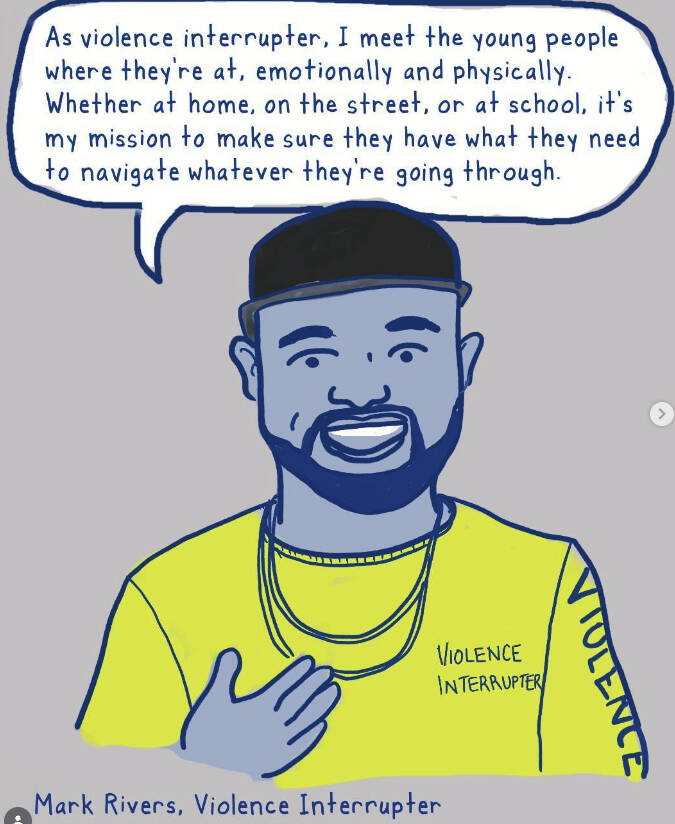
Rivers also spoke during the council workshop and explained how the team members wears bright yellow shirts to make them visible at scenes and make people aware of their community violence intervention (CVI) work. Rivers said people wonder what that truly means.
“Sometimes it is stepping in between two young people when they’re going to fight,” Rivers said. “But more than anything what it’s about is having that relationship and I always say it’s the secret sauce. Will they listen to you at a time where their emotions are not regulated? Can you get them to come back to normalcy and listen for a second so that their emotions don’t allow them to make a wrong decision that cost them their life? That’s the secret sauce. So when we intervene, that’s what we intervene with, with that relationship.”
Rivers gave a recent example of a potential violent incident they were able to stop.
Rivers said there was a young person who used to come down to Kent Station and be one of the bullies or tough guys. He eventually got into weapons.
“He was put out of school from up here in Kent and he’s out south somewhere,” Rivers said. “Well, yesterday (June 1) him and his friends, they decided that they want to come back to their old territory.”
Rivers said the teen used to be on one of Community Passageways team member’s caseloads. They found out there was going to be a fight.
“Might be weapons involved,” Rivers said. “We made a plan today. We called him, didn’t answer. We made a plan today to still go down and where most people they would run away and they would use the resource of Chief Padilla and and his officers that are already already stretched thin. But if we don’t have to and we have the relationship, we’re also part of the public safety ecosystem, then why can’t we be called in?”
The Community Passageways team decided to go to the transit center.
“We went down there and we made sure that passage was safe for those kids coming from Mill Creek and Kent Meridian to make it home today,” Rivers said. “I got a text I think an hour before I got here (to the council workshop). It said everything’s all green. Green means it’s good. They came, some of his friends came, we met him before they could get all the way off the bus and we rerouted him and was able to take him out of there and the rest of the kids were able to feel safe. Without us there, who has that relationship?”
Padilla has noticed the difference Community Passageways can make.
“They’ve been there connecting with the kids and in addition to our additional visible presence, we are seeing incidents go way down,” Padilla said. “We have a lot more data to to collect, but this is definitely a good trend.”
Eleuthera Lisch, director of the Regional Office of Gun Violence Prevention, Public Health – Seattle & King County, spoke to the council as well. The county contracts with four organizations in its effort to reduce gun violence. She said her office contributes about $700,000 annually to the city of Kent to cover the community violence intervention program under the umbrella of what the county calls the regional peacekeepers collective.
“These organizations partner very closely with each other and work together because violence doesn’t respect or gun violence doesn’t respect a border or boundary,” Lisch said. “What affects south Kent can affect north Auburn. And it’s very important for us to be able to make sure that there’s a web of support for our young people.”
Lisch said these services are focused on 12 to 24 year olds at risk of being either victims or perpetrators of gun violence in the near term. She said it’s important to provide them extensive and comprehensive services because that reduces risk for everybody.
The county program covers Kent, Federal Way, Renton, Burien and unincorporated King County, including Skyway and White Center. Youth that work with Community Passageways come from a variety of referrals, Lisch said, including families, schools, hospitals and law enforcement.
“What we do know is law enforcement and community partnerships are the best and most contributing factor to date,” Lisch said about the reduction in violent crimes.