Residents spot black bear in Kent East Hill neighborhood
Published 5:31 pm Monday, June 8, 2026
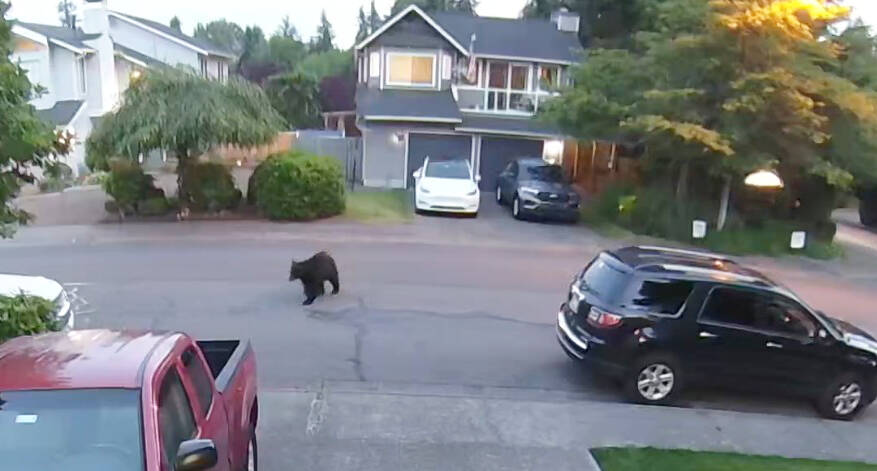
Dave and Debra Entenman have lived in the Meadow Glen neighborhood on the East Hill in Kent for 30 years and never seen a bear on their street until Sunday night, June 7.
“I just wanted to report a bear sighting in our neighborhood at about 9:26 p.m. at the corner of SE 221st Street and 116th Avenue SE,” Dave Entenman said in a June 8 email, which included a photo, to the Kent Reporter.
The black bear didn’t stay long.
“To the best of our knowledge, it did not,” said Dave Entenman, whose wife Debra Entenman is a state representative from Legislative District 47. “We last saw it heading north on 116th Avenue SE.”
Dave Entenman said nobody had to scare the bear away.
“My guess is that it couldn’t find food in our area, and left for better prospects,” he said.
Jennifer Sepulveda, spokesperson for the Washington Department of Fish and Wildlife (WDFW), said reports about black bear sightings to the state are common this time of year, including in the Kent area.
”Black bears are common throughout much of Washington,” Sepulveda said. “It is not unusual to see a black bear in our state, even in suburban areas or in greenbelts around cities and towns. Simply seeing one shouldn’t be immediate cause for concern.”
Black bears are naturally wary of humans but can overcome their fear when people reward them (intentionally or unintentionally) with high-calorie food sources, Sepulveda said.
“It isn’t uncommon to see a bear in developed areas where they are drawn to attractants like garbage cans, pet food, or birdseed,” she said. “WDFW responds to a variety of situations involving black bears every year, and most are due to human-provided attractants leading to preventable encounters near someone’s home. By securing backyard bear attractants, people can help reduce the likelihood of this kind of encounter.”
A pound of birdseed provides 1,700 calories, compared to only 600 calories from a pound of blueberries, Sepulveda said.
“Imagine how many calories are in your garbage can,” she said. “Removing human-provided food sources is the best way to encourage bears to move along and lower the chance of human-black bear conflicts.”
If you encounter a black bear, follow these steps:
• Stop, remain calm, and assess the situation. If the bear seems unaware of you, move away quietly when it’s not looking in your direction.
• If a bear walks toward you, identify yourself as a human by standing up, waving your hands above your head, and talking to the bear in a low voice.
• If you cannot safely move away from the bear or a black bear continues toward you, scare it away by clapping your hands, stomping your feet, and yelling.
• Do not run from the bear. Climbing a tree is generally not recommended as an escape from an aggressive black bear, as black bears are adept climbers.
• In the unlikely event a black bear attacks you, fight back aggressively using your hands, feet, legs, and any object you can reach. Aim for the eyes or spray bear spray into the bear’s face.
Urgent reports of bears or other potentially dangerous wildlife that present public safety concerns can be submitted to WDFW by calling 360-902-2936, emailing WILDCOMM@dfw.wa.gov, submitting an online report at wdfw.wa.gov, or by calling 911.