
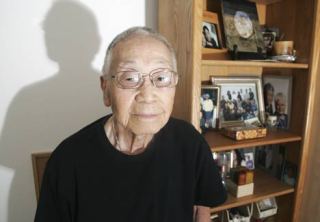
Just one month after Kaz Fujita graduated from Fife High School in 1942, he and his family received an order from the federal government to report to Camp Harmony at the Puyallup Fairgrounds.
Because of their Japanese ancestry, Fujita, his mother, brother and two sisters had to leave their Fife home. An executive order from President Franklin Roosevelt excluded Japanese Americans and nationals from the West Coast.
Fujita and his family spent about three months at the temporary camp in Puyallup before they joined nearly 9,000 Japanese Americans during World War II at the Minidoka internment camp in Hunt, Idaho. An estimated 110,000 Japanese were relocated to camps across the nation from 1942 to 1945.
“That was hard on my parents,” said Fujita, 84, in an interview Tuesday at his Kent apartment at the Arbor Village retirement community. “We were still young. But we had a farm that we rented to some Filipinos to run.”
FBI agents had removed Fujita’s father, Frank Fujita, from their home in December 1941, shortly after the bombing of Pearl Harbor, in an effort to track down Japanese community leaders. Four agents searched the Fife home, barn and vehicles and took Frank Fujita to a Seattle immigration office. Federal authorities transferred Frank Fujita to a camp in Montana and then to a camp in New Mexico before he was finally reunited with his family in 1943 in Idaho.
“It was because he belonged to a Japanese (social) club,” Fujita said on the arrest of his father, a truck farmer who sold vegetables at a farmers market in Tacoma.
Fujita’s parents had moved to Washington from Japan in the early 1900s. Fujita was born Nov. 16, 1923, in Fife.
Fujita lived two years at the Idaho camp, patrolled by tower guards. However, he spent much of that time away from the camp, working vegetable farms in Montana and Washington.
“We were free to go out and help farmers with their crops,” Fujita said.
Fujita received a letter in 1944 at the camp to report to active duty for the U.S. Army. He attended basic training in Alabama and additional training at Fort Snelling in Minnesota. The army then sent Fujita in 1945, just after the war had ended, to the Luzon Prisoner of War Camp in Manila, Philippines, to interrogate Japanese prisoners.
“We had to find out who they were,” said Fujita, who spent nine months in the Philippines. “We had to get information. We found out who was alive in Japan and let the families know who was alive.”
Fujita worked closely with 22 others in interrogation work to help process the thousands of prisoners in order to return them to Japan. Up until the 1990s, Fujita used to gather with the 22 other veterans for reunions in Reno and Hawaii.
“There’s only about five or six of us left,” Fujita said. “There are no more gatherings because we’re dying and we’re old and don’t travel that much. But we had fun while it lasted.”
After his military service in the Philippines, Fujita visited his grandparents in Japan. He had met them before the war, when they lived in Tacoma before moving back to Japan.
Fujita was discharged from the Army in 1946 at Fort Lewis. He went back to work on the Fife family farm.
“It took us about five years to get the farm back in shape,” he said.
In the late 1940s, Fujita came down with tuberculosis and spent two years recovering at a Vancouver hospital. After more work on the family farm, Fujita moved in 1951 to Seattle and worked as a city of Seattle engineer for 31 years.
He married his wife, Yoshiko (known as Yo), in 1953 and has four children and nine grandchildren. His wife died at the age of 84 in 2006, about a year after they had moved from Seattle to Arbor Village to be closer to their daughter in Kent.
After Fujita retired in 1984, he worked 13 years as a ticket taker at the Kingdome.
“It was just something to do,” Fujita said. “You meet a lot of people.”
Fujita doesn’t plan to do anything special next week on Veterans Day. But he does plan to pause to think about his life in the internment camp and the military. He said he is not bitter about being removed from his home, but still has trouble understanding it. He knows the Japanese Americans were singled out because of their looks.
“They had to do something, but what about the Italians and Germans?” Fujita said. “With us, they could tell.”
Chinese Americans would wear buttons that read, “I am Chinese,” to help separate themselves from the Japanese, Fujita said.
Along with many other Japanese Americans who had been sent to internment camps, Fujita received a check for $20,000 from the federal government in 1990 as an apology. But that check didn’t resolve much for Fujita.
“The ones who deserved it were our parents because of what they went through, and most of them were dead by then,” Fujita said. “We just put the money in the bank.”
Fujita, who suffered a stroke in 2000, now uses a walker to get around.
“My family told me I died about three times, but I kept coming back,” Fujita said of the stroke.
Fujita takes daily walks around the block at Arbor Village. It takes him about 20 minutes to walk from 116th Avenue to Southeast 240th Street and back home along 114th Avenue.
“My body is my motor and my legs are my transmission,” said Fujita, who also likes to do word puzzles.
Living at Arbor Village has been a good fit for Fujita.
“I enjoy it here,” Fujita said. “The caregivers really help us out. They do a lot of work.”
Brian Prouty, director of sales and marketing at Arbor Village, had heard Fujita’s story and helped set up the interview with him.
“He’s a very humble man,” Prouty said. “He doesn’t quite know why you want to hear his story. But it is a fascinating one.”
Talk to us
Please share your story tips by emailing editor@kentreporter.com.
To share your opinion for publication, submit a letter through our website https://www.kentreporter.com/submit-letter/. Include your name, address and daytime phone number. (We’ll only publish your name and hometown.) Please keep letters to 300 words or less.
