
(This is the third story in a several-part series about Kent’s recently passed traffic-impact fees, and the balance that must be struck between bringing in development and the cost for expanded infrastructure.)
The City of Kent has approximately 300 miles of roads, with a replacement value nearing $1 billion.
Those are roads that get used day in and day out, regardless of recessions, repair costs or tie-ups from train crossings.
“The problem is when you’ve got an asset worth that amount of money, you have to maintain it,” said Tim LaPorte, public works director for the city.
With roughly 500,000 trips a day on streets in Kent’s jurisdiction, that’s no simple feat.
“The transportation costs are always a problem because they’re so bloody expensive,” LaPorte said.
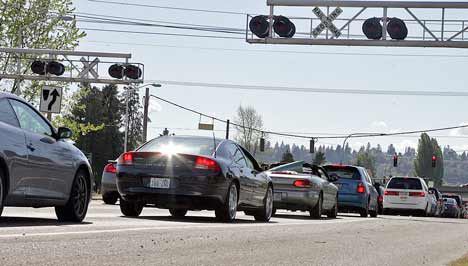
But city staff over the years have developed a reputation for being good at securing grant money. In fact, the city has more than $26 million in grant funding accumulated from a variety of state and federal sources, for seven of its highest-priority road projects. These are projects that would enable the city to help unclog the growing congestion on its streets, as well as making tie-ups from train crossings a thing of the past.
Sounds good so far, right?
The problem is that all of those funding sources, no matter how they are cobbled together for specific projects, still do not cover the whole costs of any of these projects.
Councilwoman Debbie Raplee explained the city’s dilemma.
“I would love to take our transportation grants and put them all together to get one done, but we can’t do that,” Raplee said, noting each grant is tied to a specific project.
For instance, the city has lined up nearly $9 million in grants from four different sources, but it’s for a railroad-grade separation proposed for South 212th Street that will ultimately cost at least $25 million.
“When you apply for a grant you have a specific project in mind,” Raplee said.
Kent really has two problems that are happening at the same time: pre-existing roads that need to be maintained for the usual wear and tear, and transportation projects – like the railroad-grade separations – that will accommodate the city’s increasing traffic capacity.
So the city is stuck with two kinds of expenses – maintenance and improvements. But without any kind of additional financial help, those expenses are coming from one pot – the city’s taxpayer-supported general fund.
“We’re getting grants, but we need a match,” LaPorte said. “We are stuck using our maintenance money as some kind of match for the grants.”
He explained the reality of the budget he has for road maintenance.
“Every year we should be putting $8 million in street overlays,” he said, of the work that helps maintain the life of Kent’s streets. “This year, I’m getting $1 million, and I’m grateful for it.”
The grants that city staff have secured reflect nearly a decade of work. And that is work that could be completely undone, without a means of a local funding match.
LaPorte explained the grant funds have a shelf life, and if a granting agency sees those dollars sitting year after year unused, eventually the city will have to give them back.
“If we lose the grant, in my opinion, the whole city loses, because it’s not coming back,” LaPorte said. “That’s kind of death, as far as I’m concerned.”
No easy decision
That’s why the Kent City Council in July, after more than a year of study, passed Kent’s first-ever, transportation-impact fees.
The fees, which came online to serious consternation in the business community, charge businesses upfront on the basis of additional traffic that new or expanded enterprises in Kent are expected to create. They’re also automatically set to climb each year for the next six years, to bring Kent closer to the actual amount of what peak-transportation trips are expected to cost.
But while they are a source of frustration for Kent’s business leaders – including the Kent Chamber of Commerce, which came out opposed to them – the TIFs, as they are called, could provide a much-needed source of revenue to get the capacity-improving projects done for Kent, creating more opportunities for prosperity down the road. It also means the city could plug its other dollars into street maintenance, ensuring its road system stays functional.
So the question becomes a multi-pronged one: Is the city right in charging fees to business, or will it further chill the tough economic climate in Kent? And should the city be paying for those railroad-grade separation projects right now, in such hard times, or should it give the money back to the state, thereby losing more than a decade of work?
One thing becomes quickly clear: the Kent City Council was faced with a highly difficult choice when it passed the ordinance back in July. Do its members feel they made the right decision?
Councilman Higgins
Councilman Dennis Higgins, who voted for the fees, said he wants to revisit the issue of the increases before they automatically go up next year.
“I’m one of the councilmembers who did voice at the time that I was concerned about the escalator clause (the automatic increases), and I wanted to make sure we could revisit it,” Higgins said. “I wanted to make sure weren’t shooting ourselves in the foot.”
He added of other cities that have TIFs, “I don’t want to jump and leapfrog those guys, if they’re not going up.”
Councilman Thomas
Councilman Les Thomas is of a different mind about the fees. He noted that while “no one wants to raise fees,” there is a “much bigger global picture here,” than just Kent.
With some of the nation’s best high-tech industries in the region, including the Kent Valley, it’s critical to ensure movement of goods and services to Eastern Washington and beyond, Thomas said.
Kent does have a major place in the flow of commerce in the Puget Sound. According to an April 2010 report from the Washington State Department of Commerce, the Kent Valley is considered the second-largest industrial park on the West Coast, and the fifth-largest in the nation. It’s linked to the ports of Seattle and Tacoma, a combined area that is considered the third-largest container hub in the nation.
In order to stay competitive nationally, Kent needs to ensure the continued ability to circulate goods, Thomas said, and that means taking on some of those capacity-improving projects now rather than later.
“We need to get some of these big projects funded,” he said. “The only way to do that is raising money from somewhere.”
Without that kind of local financial backing, the city is stuck having to give back grants, Thomas said, meaning “we’re going to lose some major support” of the granting agencies from whom the city has won project dollars. It’s an action that could hurt Kent down the road, when it applies for future grants.
As for the automatic, stepped-fee increases, Thomas said he voted in favor of them because “I just don’t like taking those back to the Council every year” – but said the Council could opt to go back and change the ordinance, so that they would not be automatic.
Councilman Harmon
Councilman Ron Harmon was the sole dissenting vote on the TIFs, back when the Council approved them in July. It’s just not a good time to be taxing business, he said in a phone interview last week, with the economy in its current state, and the city should be removing some of the most expensive projects from its to-do roadwork list – the Transportation Master Plan.
“Now’s not the time to be raising taxes,” Harmon said, adding “we should be looking at the possibility of removing the grade separations (the priciest projects) from the transportation-fee list.”
Harmon pointed out that while the city could point to the grants it’s received for these projects, in reality, those grants are only paying for a small portion of the total cost, making the projects unrealistic to accomplish.
“The problem is that it’s a very small amount of money – each project runs between $20-$30 million,” Harmon said, of the overall projects, versus what the city has received in the way of grants. “”If we have grade-separation (grant) money of up to $5 million, that’s still going to leave a $20 million hole.”
At the very least, Harmon said, the city should be shelving the TIFs for the time being.
“Oh, absolutely, emphatically,” he said. “We should look at putting in a moratorium on it for at least a year, then taking a look and revisiting the whole issue.”
Council President Perry
Council President Jamie Perry noted the clock is ticking, in regard to the projects in the city’s Transportation Master Plan, and they’ve been put off long enough.
“It’s gotten to the point where we can’t sit on this anymore,” she said.
Every time a granting agency promises dollars for a project, and those dollars go unused for multiple budget cycles, questions start to arise about whether the grant recipient can realistically make the project happen.
“We have a really great reputation,” she said, of the city’s ability to put grant dollars to work. “But that reputation starts going down” if the city begins to hand grants back, because it couldn’t make the project happen.
That loss in reputation will hurt the city in years to come, when it tries to apply for grants down the road. Why would a granting agency take a risk on an entity that’s gained reputation for sitting on projects?
“Getting a grant in the future gets harder and harder,” Perry said.
With close to 50 percent of the projects on the Transportation Master Plan related to growth, Perry said she felt it right to charge TIFs, especially when the cities around Kent also are charging similar fees.
“Growth should pay for growth,” she said.
Councilwoman Raplee
Councilwoman Debbie Raplee said she is in support of the fees.
“We just have a tremendous amount of work we need to get done,” she said. “There isn’t a lot of money we can apply for to finish projects.”
For those critics who think the city should simply cross the railroad-grade separations off the list, and hand the related grant back to the state, Raplee said the problem is a lot more complex than that.
“With the economy that the state and the country are in, they’re not going to have that money to give out again – it’s lost forever,” Raplee said.
And like Perry, she noted the city’s reputation begins to look like a red flag to granting agencies, when projects remain undone.
“Sure, it’s easy to give (the grant) back, but the trouble with that is you lose your track record,” she said.
“You’re kind of like on a list that says ‘we’re not giving you any more.”
Councilwomen Debbie Ranniger and Elizabeth Albertson were not available for comment. Ranniger was out of town dealing with a family issue – a new grandchild – and Albertson didn’t return calls to her cell phone last week.
Talk to us
Please share your story tips by emailing editor@kentreporter.com.
To share your opinion for publication, submit a letter through our website https://www.kentreporter.com/submit-letter/. Include your name, address and daytime phone number. (We’ll only publish your name and hometown.) Please keep letters to 300 words or less.
