Do opportunity zones in King County work?
Published 12:20 pm Tuesday, July 21, 2020


When opportunity zones were approved in 2017, they were touted as a way to create jobs and inject capital into low-income neighborhoods by attracting investments through a federal tax break.
But today it remains unclear if the zones are working as intended in King County.
These zones were created in economically struggling census tracts across the U.S. as part of the 2017 federal Tax Cuts and Jobs Act. The program allows investors with capital gains, or profit from stocks and investments, to pump money into a broad range of projects in opportunity zones. It then waives federal taxes for projects that investors hold onto for at least 10 years.
Last winter, Congressional Democrats called for investigations into businesses developments in the zones, and legislative fixes to ensure money was invested into projects that helped the communities they were in. One bill would prohibit industries like luxury housing from benefiting from the tax cut. Another would require annual reports on which projects are utilizing the zones benefits.
Across the U.S., there are more than 8,700 opportunity zones.
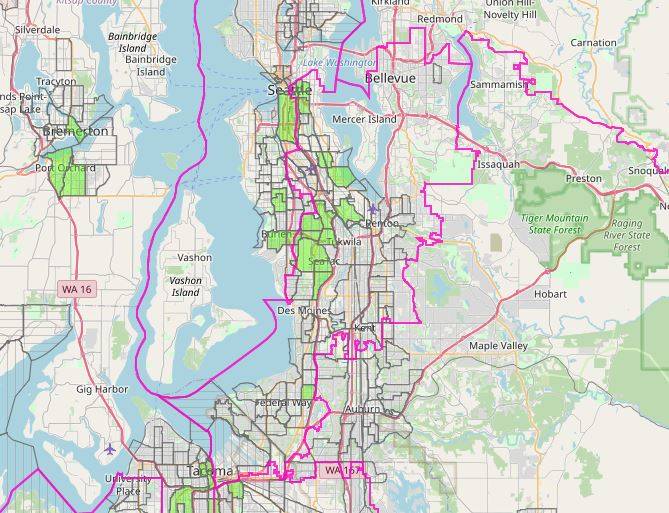
In King County, there are more than 113,200 people living in 23 designated opportunity zones. Most of them lie in central and south Seattle and South King County cities like Burien, Tukwila and Federal Way.
On average, residents of the county’s opportunity zones are about twice as diverse as the King County average.
The families living in these areas are also poorer on average than those in other areas, with an annual median income nearly $34,000 lower than the King County average, according to an Urban Institute report released in June 2020.
Despite being pitched as a way to boost local jobs and infrastructure, there are few restrictions on what kinds of projects can utilize opportunity zone tax breaks. This led analysts, nonprofits and developers to question how effective the program is at attracting investments to fund businesses, jobs and provide accessible housing and services that benefit their communities.
And there’s no requirement in federal law for developers in opportunity zones to work with communities they’re operating in, other than what is typically required by local municipalities for projects.
And crucially, there’s no reporting mechanism. The Internal Revenue Service doesn’t collect data on who is using opportunity zone tax breaks, or what projects they’re using it for.
This makes it difficult for researchers like Jorge Gonzalez, with the Urban Institute, to track what’s happening on the ground. But after conducting some 70 in-depth interviews with project sponsors, fund managers, investors, developers, nonprofits and other stakeholders, the organization published its findings in the report.
“We may never know really the extent to which this program ended up helping wealthy investors, and probably not really delivering for the communities, and delivering on its goal,” Gonzalez said.
The report
The Urban Institute report found there was some interest from developers and investors who haven’t historically engaged in community development projects. The zones seemed to highlight the areas for potential investors who hadn’t considered undertaking projects in them before.
But most community-based organizations and nonprofits struggled to find investors.
“Unfortunately, based on our interviews of people involved in (opportunity zone) projects and attempted projects to date, the structure of the incentive appears to be least workable for the projects that could have the highest impact around these issues,” the report states.
Tax incentives for the zones are structured to provide the biggest breaks to the most expensive projects. This means that community-oriented developers, who may want to use the zones to build affordable housing or retail, have to search for “not so ordinary rich people,” said Sarah Lee, with the Washington State Department of Commerce.
These are wealthy people who, instead of trying to maximize their financial returns by creating market-rate housing or luxury real estate developments, prioritize projects that enhance their community. Affordable housing developments generally have an expected rate of return of between 3 and 7 percent, far less than the 10 to 14 percent return on investment for market-rate developments, the Urban Institute report states.
Some 94 percent of taxable capital gains, the only source of funding that qualifies investors for the opportunity zone tax break, are owned by households with gross incomes of more than $100,000. Meanwhile, only 12 percent of opportunity zone residents live in households with incomes earning more than $100,000.
“At the end of the day, people from outside zones will largely be making investment decisions that affect zone residents,” the report states.
Washington state has no special regulatory power over opportunity zones. Instead, it works with project developers to shore up their pitches, and finds interested investors.
But so far, all the projects Lee has seen move forward in opportunity zones were already in the pipeline when the program was created. And these projects often utilize a number of different funding sources, not just the federal opportunity zone tax breaks.
“Opportunity zones by themselves can’t create a project,” Lee said. “So that’s the downside with opportunity zones, that they didn’t say ‘Ok, here’s one more tool in your toolbox. Here’s what you need to take advantage of it, and here’s all the rest of the financing and capital and equity tools that you need.’”
On its own, opportunity zones only add a couple percentage points to a project’s profit, Gonzalez said.
The Urban Institute report states there had been more than $10 billion invested in opportunity zones across the U.S. before the COVID-19 pandemic struck. But since these investments are funded by capital gains, and not debt, it forces partnerships between developers and investors, which can be challenging for community-funding programs, said Chuck Depew with the National Development Council. This presents a problem for businesses and business investors.
Business owners may be reluctant to bring on a partner who buys equity in their business to qualify for the opportunity zone tax break, instead of taking out a loan. And business investors may not want to wait 10 years before selling their share of a business when it becomes more profitable.
As a result, the Urban Institute report states that only 4 percent of investments into opportunity zones across the country are going towards operating businesses.
A handful of developments
But there have been successful projects that have utilized opportunity zones, like the Canton Lofts in Seattle’s Pioneer Square neighborhood. It’s slated to deliver 80 units of workforce housing for people earning 80 percent of the area median income, or for people earning between $60,000 to $90,000 a year, the Seattle Times reported last year.
Another is the Othello Square project, which will include market-rate apartments, a community clinic, a housing co-op for families making less than 80 percent of the area median income, and affordable commercial space.
The community development nonprofit Forterra has also gathered $13 million for opportunity zone projects, said CEO Michelle Connor. They’re currently in negotiations for projects in King County zones.
Forterra’s financial resources and investor connections allowed it to hire a for-profit securities law firm to set up the legal framework for their opportunity zone fund. But for many smaller organizations, this would be impossible, Connor said.
“It was a hard push to get this thing in place,” she said.
Connor said if the investors in the zones are only people looking for high rates of return on their investment, then development within them will be driven by for-profit entities.
Forterra is thinking about how to serve as an administrative backbone, providing infrastructure for smaller organizations.
“How do we be that resource for other community groups, so there’s cost effectiveness,” she said.
Many zones lie in south King County in areas with many businesses owned by people of color. Several businesses, like those housed in the SeaTac Center, lie in old strip malls and buildings that the owners are keen to redevelop. As the economy boomed before the pandemic, many of these businesses were at risk of displacement.
Seattle-based developer Jaebadiah Gardner, CEO of Gardner Global, is working on an opportunity zone project in a historically Black neighborhood in Seattle. The neighborhood has been gentrified, but Gardner is hoping to figure out how to create community buy-in for the project, which will create up to 100 units of affordable and workforce housing.
While opportunity zones can be a good tool for community developers, he sees the same potential problem — that they could increase gentrification. Gardner said there should be a way for communities in opportunity zones to invest in projects that impact them.
“The flip side is those developers, there’s the potential, because there’s no regulations on what they can develop or how they can develop,” Gardner said. “So the people in that neighborhood are going to be subject to projects that they may or may not be able to live in.”