
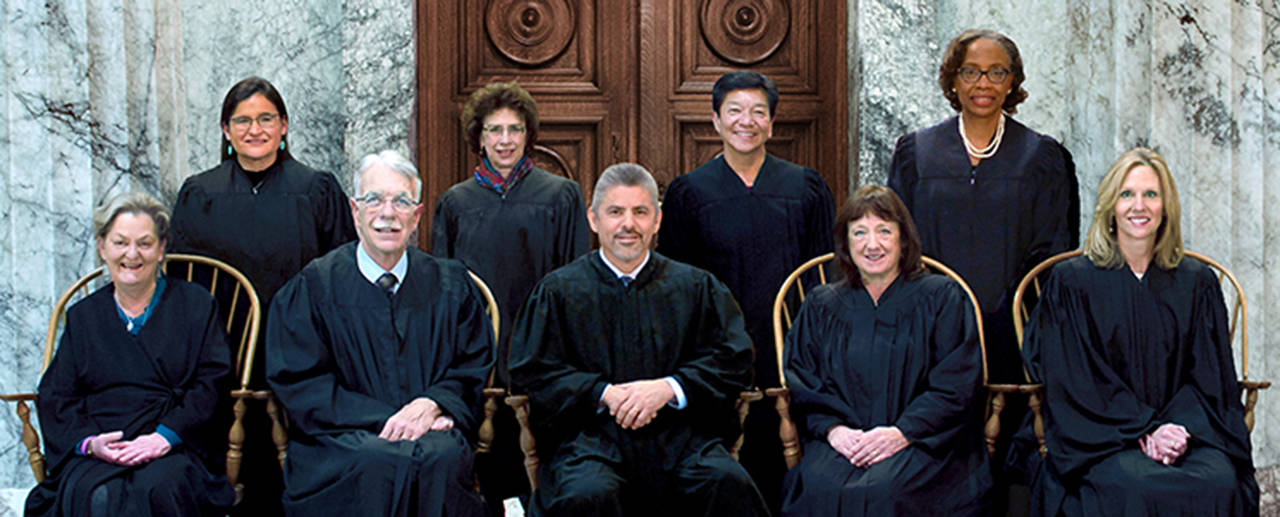
A Feb. 25 state Supreme Court ruling has struck down the Washington law that makes simple drug possession a crime.
The now-stricken law made possession of a controlled substance a felony punishable by up to five years in prison and a hefty fine. Five justices, led by Justice Sheryl Gordon McCloud, said in the 5-4 ruling the statute was unconstitutional because it doesn’t require prosecutors to prove that someone knowingly or intentionally possessed the drugs.
Local authorities can no longer arrest someone solely because the person has a few grams of heroin, methamphetamine, cocaine or other illegal drugs — unless, however, there is suspicion that the individual intended to deliver those drugs, according to Snohomish County Prosecutor Adam Cornell. About a half-dozen people will be released from his county’s jail “as soon as possible” as a result of the decision, Cornell said. Those inmates were awaiting trial for simple drug possession alone, or serving sentences after being convicted of only those charges.
Pending criminal cases in which simple drug possession is the only charge will also be dismissed, he said.
Prosecutors, public defenders, police and lawmakers across the state are delving into the far-reaching implications of the decision.
Convictions could be vacated for people found guilty of simple drug possession in the past. And there’s not yet a clear consensus on what the decision will mean for people who were given longer sentences for other crimes because of prior simple drug possession offenses — a common outcome of the state’s offender “scoring” system.
Under another state law, possession of a controlled substance remains illegal if there is intent to distribute, sell or otherwise deliver the substance. Police can also still arrest people for possession of drug paraphernalia, Cornell said.
Some municipal police departments in King County have responded to the ruling, noting officers will no longer make arrests for drug possession as they would have under the former law.
“From this point on, officers no longer have the authority to conduct a criminal investigation, effect an arrest, seek a search warrant, or take any other law enforcement action for simple possession of controlled substances. To clarify: simple possession of drugs has now been legalized,” according to Renton Police Chief Jon Schuldt’s post on the department’s Facebook page. “I wanted you to be aware of the new constraints that our officers must now work under and ask for your understanding. The safety and well-being of our community continues to be our top priority, but as you can imagine this recent ruling will have a dramatic effect on our community. We will be contacting our state legislators in an effort to work together to amend the Supreme Court’s decision on this matter.”
Snohomish County Sheriff Adam Fortney expressed shock in the ruling in a post to his Facebook page.
“I was notified this morning that the Supreme Court found Washington State law against drug possession to be unconstitutional. No, this is not a joke this actually happened today,” he said in the post. “I have a meeting later in the day with our Prosecutor to try and work through what exactly this means moving forward. When I have more information I will share it but to speculate now wouldn’t be helpful.”
Island County Sheriff Rick Felici said in a written statement that the effects of the decision will be “widespread to say the least.”
“While it could be argued that this change will reduce the number of people incarcerated in the state, and that drug abuse is better treated as a public health issue, this change will also have an impact on the number of people who were motivated to get into treatment as a result of their arrest,” Felici wrote. It will also “impact law enforcement’s ability to ‘work their way up the chain’ to get to drug dealers,” he added.
State Rep. Lauren Davis, strategy director of the Washington Recovery Alliance, said the decision “gives renewed urgency to the conversation about our state’s response to untreated substance use disorder.”
Davis, a Democrat whose district includes Lynnwood and Edmonds, sponsored a bill this legislative session that would eliminate some of the criminal penalties for drug possession and expand treatment and support services.
“We must stop criminalizing symptoms of a treatable brain disease,” Davis said in an email. “Today’s decision does that. But that alone is insufficient. It is equally important that we build out a response to substance use disorder that truly works — a robust and fully funded continuum of care ranging from outreach to treatment to recovery support services.”
Until the decision, Washington was the only state that did not require proof of intent for drug possession to be considered a crime, according to the state Supreme Court ruling in the case, known as State v. Blake.
But the ruling does not clarify what constitutes intent to deliver, leaving that key legal question to local prosecutors and police to answer for now.
The state Legislature could rewrite the stricken statute to include standards for proving intent.
Those counting on lawmakers for any kind of guidance could be disappointed, at least in the near future.
With the session nearly half over and a pandemic forcing lawmakers to work virtually, it would be very difficult to negotiate agreement on any legislation.
“I don’t know what direction we’re going to go. I want to hear from everybody,” said Rep. Roger Goodman, D-Kirkland, chairman of the House Public Safety Committee, where any bill would be considered.
Even before the court’s decision, many House Democrats had embraced efforts to decriminalize possession of small amounts of narcotics.
“I think the Legislature is going to have to take action on this,” Goodman said. “I can’t say what that might be.”
Democratic Sens. Mark Mullet and Steve Hobbs have moved swiftly to make possession of a controlled substance a felony again.
Senate Bill 5468 on Monday’s (March 1) introduction sheet would restore the law and, to remedy the problem cited by justices, add the word “knowingly” to the statute.
–
Herald reporter Jerry Cornfield contributed to this article.
Talk to us
Please share your story tips by emailing editor@kentreporter.com.
To share your opinion for publication, submit a letter through our website https://www.kentreporter.com/submit-letter/. Include your name, address and daytime phone number. (We’ll only publish your name and hometown.) Please keep letters to 300 words or less.
