
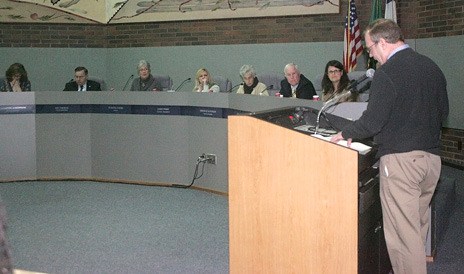
Kent business leaders came away pleased Tuesday with changes the Kent City Council unanimously adopted to its transportation-impact fees – especially a controversial part of the previous ordinance that would have automatically bumped the fees up every year for the next six years. As a result of the change, Council members now will evaluate whether to increase those fees each year, as opposed to the previous automatic increase.
Jim Brownlow, Kent Chamber of Commerce president, told the Council before its 7-0 vote that he agreed with changing the automatic increases.
“I do want to thank the staff and the Council for recognizing the Kent Chamber of Commerce’s concerns regarding this ordinance and taking action to remedy some of those concerns,” Brownlow said.
Ever since the Council adopted the TIF ordinance back in July, as a means of funding improvements to Kent’s road system, the local business community has raised questions about it. The fees, which became effective in August, were designed to generate revenue from retail and residential developers so the city could get some long-awaited transportation projects off the ground.
“No ordinance is perfect,” Council President Jamie Perry said prior to Tuesday’s vote. “We are going to make it better and more friendly for the business community. Given the economic condition we’re in, we’re presenting a more realistic ordinance and it gives us a little more flexibility to make sure we are business-friendly here and some of those vacant spaces can be filled without significant transportation impact fees.”
Andrea Keikkala, executive director of the Kent Chamber of Commerce, attended the meeting to see what the Council would do.
“I think it definitely helps,” Keikkala said in a phone interview Wednesday, of the Council vote. “We’re very grateful that city has had this dialogue. We’ve always been against a Transportation Impact Fee, but at least they were willing to go back to the ordinance and do some fixes.”
Councilman Ron Harmon said the Council must continue working with the business community and come up with a priority list of transportation projects for the city to fund and complete. He proposed that the Council’s Public Works Committee form an ad-hoc committee that includes local business leaders to prioritize projects.
“They can look at what projects we want to fund locally and come up with a list, work with staff and in turn be able to project what kind of transportation-impact fees are warranted,” Harmon said. “Maybe the fees we have at the present time would be only one part of the plan.”
The Public Works Committee will decide whether to move forward with looking at changes to the Transportation Master Plan and which projects should be done, Perry said.
Keikkala said Wednesday she liked the idea of a committee to make a list of the top projects. The chamber presented such a list to Mayor Suzette Cooke in July 2009 that ranked (the very expensive) railroad-grade separation projects at Willis Street and South 212th Street as the top projects to enable traffic to avoid having to wait for trains by going over or under the tracks.
“We want to be at the table for that committee if it starts to work with the city to prioritize the list,” Keikkala said.
Harmon said a committee is needed because the revised ordinance doesn’t do enough.
“I voted against the transportation impact fee as it was originally proposed because I knew it would throw a huge burden on redevelopment and keeping businesses in Kent,” he said. “What we’re doing tonight is the right thing to do, but it is a Band-Aid fix.”
Councilwoman Deborah Ranniger agreed it’s time to for the city to re-examine what street projects to do first rather than following a plan compiled a few years ago.
“I also believe that list was created pre-recession and is rather ambitious,” Ranniger said. “Perhaps in the world we are in today, I think there is some room for revisiting that list and perhaps scaling it back. I don’t think we are going to need to or want to do all of those projects, especially with how the economy is.”
The fees average about $4,084 per peak hour trip, according to city officials. Downtown-area fees are about 25 percent lower because the impact fee calculation assumes fewer trips due to the close proximity of amenities and public transportation options.
The fees are expected to generate an estimated $89 million in revenue by 2017 to help pay for $389 million in transportation projects. That revenue number could go higher or lower depending on how much actual development occurs each year.
Under the ordinance, the city charges transportation impact fees, or TIFs, up front to new developments (retail and residential) as well as when pre-existing structures see a major change in use. The rate of the TIF depends on the kind of development being proposed: single-family residences pay a different rate than a hotel, as would a warehouse, or a movie theater. The key is how much more traffic each would put on Kent’s roads.
Talk to us
Please share your story tips by emailing editor@kentreporter.com.
To share your opinion for publication, submit a letter through our website https://www.kentreporter.com/submit-letter/. Include your name, address and daytime phone number. (We’ll only publish your name and hometown.) Please keep letters to 300 words or less.
