
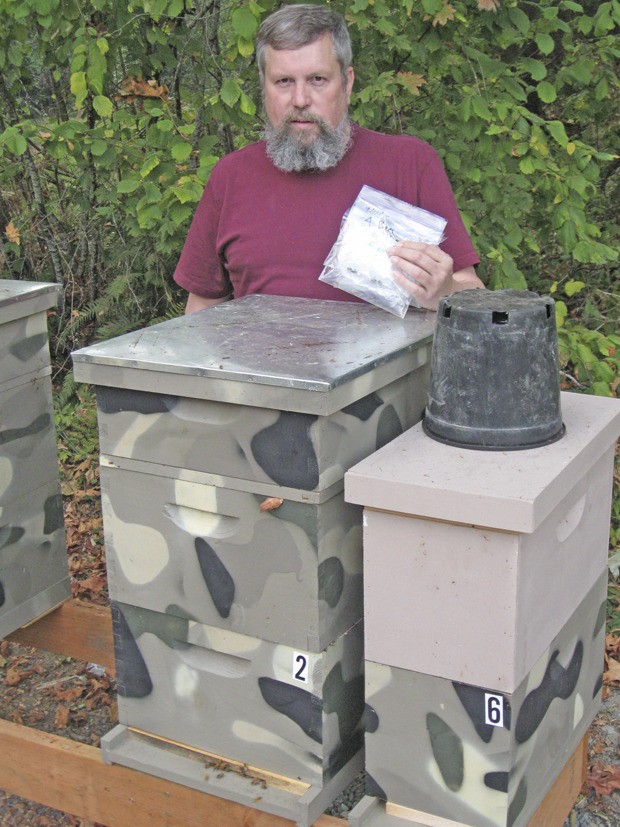
After being the most recent man to report “zombie bee” sightings in Washington state, Kent’s Mark Hohn has received a slew of attention from throughout the world.
First on the scene was the Seattle Times, followed by three local TV stations. Then the amateur beekeeper was visited by National Public Radio’s KUOW and also KJR radio. He found an article on London’s Daily Mail science page and also the original Times article translated into about six different languages.
“So yeah, it was a pretty big deal,” Hohn said. “It made the Washington Post; it was on CNN.com and USA Today.”
So what are these “zombie bees” that have garnered such attention? Hohn, who just became a beekeeper this year, traces back to when he first discovered the odd occurrence.
Hohn returned from a vacation in July to discover a bunch of dead bee bodies lying in front of the shop he has in the back of his house. Thinking it was normal, he just blew away the bodies with his leaf blower.
Then three weeks later, he discovered an online post from someone in Oregon reporting bees behaving strangely. They were said to buzz around lights and crawl on the ground and die.
Hohn took about five bees off the floor of his shop, put them in a plastic bag and didn’t think anything more of it for about a week.
“Saturday morning I go out to the shop and look at this bag and there’s pupas in with the bees, that I didn’t put in there,” Hohn recalled. “So, I knew something was up.”
He took photos and sent them off to zombeewatch.org. ZomBee Watch is a citizen science project that tracks the zombie fly, Apocephalus borealis, that parasites honey bees. The website and watch are a project of the San Francisco State University’s Department of Biology.
John Hafernik, biology professor at SFSU, and Steven Sheppard, entomology professor at Washington State University, showed interest in Hohn’s evidence that he sent them separately.
Two weeks after Hohn sent him a photo, Hafernik confirmed that Hohn had indeed found “zombie bees” in Washington.
“Zombie bees” are honey bees that have been parasitized by the zombie fly. The fly bites the bee putting its eggs inside the honey bee. Four to six weeks later, the pupas hatch into flies that eat their way out of the honey bees.
“This is a native fly whose native hosts include bumble bees and yellow jacket wasps,” Hafernik wrote in an email. “It is now attacking the non-native honey bee. Parasitized honey bees abandon their hives at night on a ‘flight of the living dead’ and often become stranded under nearby lights.”
Hafernik’s citizen group, ZomBee Watch, he runs with his colleagues, has been following cases throughout the country. The goal is to see how big the threat is to honey bees and how widespread is the parasitism.
“It could be an important player in hive failure or it could be a minor player in a bee movie,” Hafernik said.
The fly does not infect humans, however, a decline in honey bees would affect human agricultural production and the kinds of fruits and vegetables humans eat, Hafernik said.
He and his colleagues have been studying this parasitism by the fly since late 2008.
There have been parasitized honey bees found along the West Coast from Santa Barbara to Seattle, the group reports. Also, DNA of the fly has been detected in hives in South Dakota and Bakersfield, California.
“The fly itself is distributed across most of North America north of Mexico,” Hafernik said. “Thus parasitism of honey bees could be more widespread.”
For now, Hohn continues to monitor the situation back at his hives in Kent. He doesn’t believe that his honey supply has been impacted, but says that there are a lot of unknowns out there.
“The goal of talking to the press was for people to take more samples,” Hohn said. “Because, we don’t know how widespread this is.”
Since Hohn’s report came out, others in the state have confirmed “zombie bee” sightings, he said.
For now, no one knows how to stop the occurrence and anything that one does to eradicate the flies might impact honey bees negatively, Hohn said.
“We need more data to find out how widespread it is and then maybe there’s something we can do,” Hohn said.
Talk to us
Please share your story tips by emailing editor@kentreporter.com.
To share your opinion for publication, submit a letter through our website https://www.kentreporter.com/submit-letter/. Include your name, address and daytime phone number. (We’ll only publish your name and hometown.) Please keep letters to 300 words or less.
