
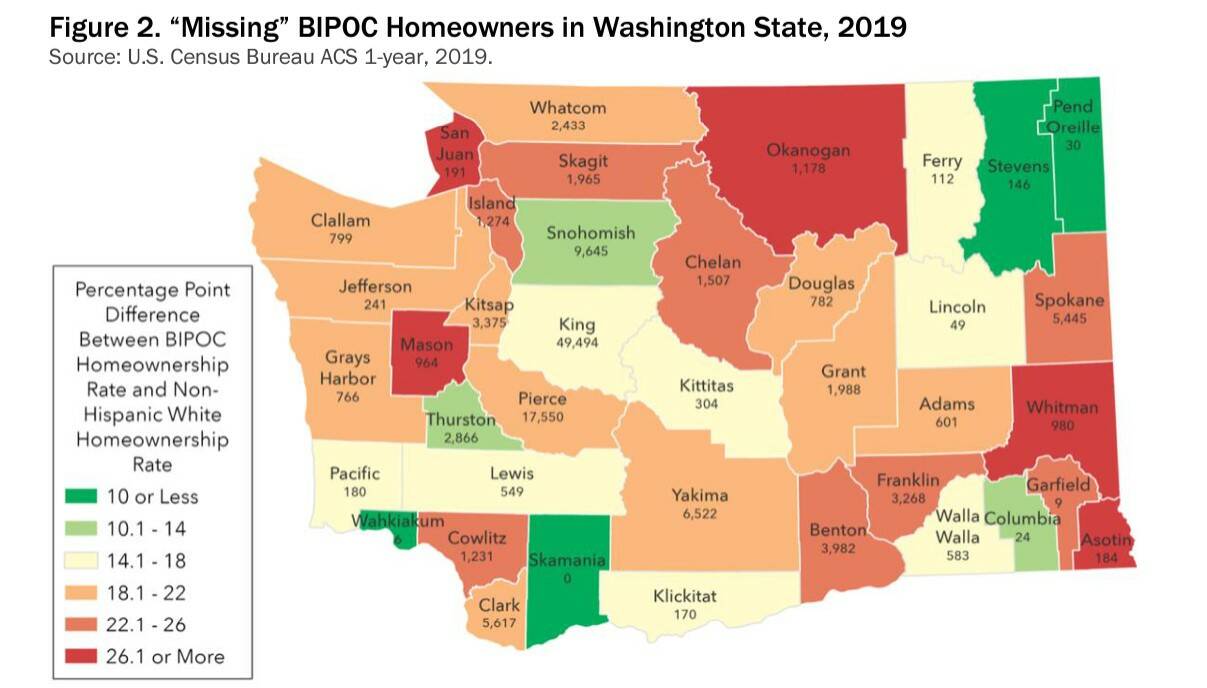
In order for there to be racial equity between Washington state homeowners, according to a recent report, Black, Indigenous and people of color need to buy over 143,000 homes.
On Sept. 27, the Homeownership Disparities Work Group released their nine-month long findings, along with their 27 recommendations to legislature and government leaders that need to be implemented in order to overcome this disparity.
“Homeownership is the primary way most households build wealth, and yet access to the opportunity to own has not been evenly distributed,” said Patience Malaba, executive director of the Housing Development Consortium of Seattle-King County and Home Ownership Disparities work group member. “Public and private sector policies have for generations built an interlocking web of barriers preventing many Black, Indigenous, and people of color (BIPOC) from achieving homeownership.”
In the report, “BIPOC” refers to Black, Indigenous, Hispanic, Latino, Asian, and other groups of people who do not identify as white, or fall within other categories.
The work group’s findings show that, despite housing discrimination and redlining no longer being legal, the housing gap is even more significant now — 60 years later.
Data from census American Community Survey shows the BIPOC homeownership rate is at 49% — a number that is slightly higher than the national rate, but lower than the percentage of non-Hispanic white households, which is at 68% (as of 2019).
Within BIPOC communities, homeownership is lowest amongst Black and Hispanic or Latino households with 31.1% and 45.4% rates, respectively.
“There is nothing more foundational than a home, and we have to ensure everyone has access to a critical resource we all depend on,” said Department of Commerce Director Lisa Brown, who chaired the work group. “The history of systemic, discriminatory policies and practices in housing has had a devastating impact on our most marginalized communities. The recommendations in this report can be a compass to guide our work to eliminate barriers and increase access to affordable housing for BIPOC communities.”
Taken directly from the report, these are 12 of the 27 recommendations, which include suggested polity revisions, funding priorities and changes to real estate and lending industries, which would need to immediately go into effect:
- Increase biennial state funding for affordable homeownership programs, including land acquisition and pre-development costs.
- Fund a technical assistance/capacity-building program to build the nonprofit organizational infrastructure to develop, finance, facilitate, build, and steward all types of affordable homeownership projects.
- Provide technical planning assistance and resources to municipal governments to increase affordable homeownership units.
- Revise Housing Trust Fund and Housing Finance Commission programs to reduce the administrative burdens on applicants.
- Increase the amount of funding available for direct assistance to homebuyers and homeowners.
- Make current programs more flexible by increasing the per-household limits on existing assistance awards.
- Target homeownership assistance to the BIPOC community via historical ties to culturally specific areas.
- Provide incentives to home sellers to accept offers from purchasers using down payment assistance programs.
- Expand debt mediation and credit repair programs.
- Ensure that awareness of homeownership programs is part of licensing and education requirements for people in the real estate industry.
- Fund culturally specific organizations for outreach to increase the visibility of and access to homeownership assistance programs for BIPOC communities.
- Explore policies to improve connections with BIPOC communities to ensure that interest in homeownership is understood by funders.
These disparities also differ between counties, with a range of BIPOC households only being at 8.7% in Lincoln County and at 66.2% in Adams County. The data shows that, besides King County — with a rate of 40.4% BIPOC households — the counties with higher percentages of BIPOC households have smaller populations and tend to be agricultural areas.
Based on the report, the counties with smaller populations would actually require fewer BIPOC households to become homeowners in order to reach parity, while King County would require the largest number of new BIPOC homeowners.
“This report is key to starting the process of removing barriers and improving access to homeownership. And, there is more work to be done. Now is the time for action. Every individual who plays a role in the homeownership process has work to do to achieve equity and justice for all,” said Dr. Karen A. Johnson, director of the Washington State Office of Equity.
The Washington Department of Commerce also announced there will be immediate implementations of the 12 recommendations that do not require legislative action.
From a press release, Commerce will “focus on and simplify administration of funding and increase the per-household investment amounts available, Commerce consolidated management of homeownership capital, foreclosure fairness and manufactured/mobile home relocation assistance programs into a new Homeownership Unit. Access to $25 million in funding for homeownership opportunities through a new streamlined application will open in mid-October.”
For more in-depth information on disparity in homeownership in Washington state, the report is available online at www.commerce.wa.gov/wp-content/uploads/2022/09/Homeownership-Disparities-Recommendations-Report-FINAL-Sep2022.pdf.
Talk to us
Please share your story tips by emailing editor@kentreporter.com.
To share your opinion for publication, submit a letter through our website https://www.kentreporter.com/submit-letter/. Include your name, address and daytime phone number. (We’ll only publish your name and hometown.) Please keep letters to 300 words or less.
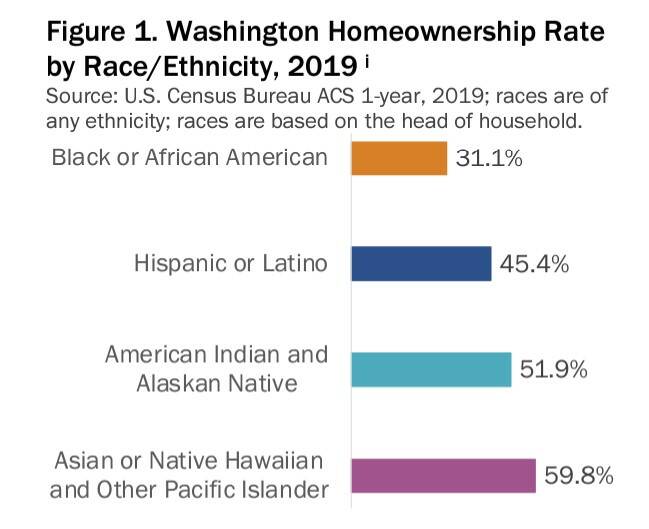
A graph from the report shows the percentage rate of BIPOC homeownership by race or ethnicity, with Black or African American homeownership being 31.1%, the lowest in Washington state. Image courtesy of Homeownership Disparities Work Group.
