Transgender Day of Remembrance (TDOR) is an annual observance on Nov. 20 that honors the memory of transgender individuals whose lives were lost to anti-transgender violence.
The week leading up to TDOR is Transgender Awareness Week, which assists with raising visibility for transgender individuals and addresses issues the community faces.
Transgender advocate Gwendolyn Ann Smith started TDOR in 1999 as a vigil to honor the memory of Rita Hester, a transgender woman who was murdered in 1998.
“I am no stranger to the need to fight for our rights, and the right to simply exist is first and foremost,” said Smith. “With so many seeking to erase transgender people, sometimes in the most brutal ways possible, it is vitally important that those we lose are remembered, and that we continue to fight for justice.”
Last year was the deadliest year on record for transgender violence and deaths since the Human Rights Campaign (HRC) began tracking the data in 2013. According to HRC, transgender women and people of color are at elevated risk of fatal violence, particularly for Black transgender women, who comprise the majority of victims.
HRC estimates that there are 2 million transgender people across the United States. The organization has already reported at least 32 transgender people fatally shot or killed in 2022. Since 2013, more than 66% of recorded incidents involved firearms and gun violence, according to HRC.
HRC expects an undercount of reported murders because some deaths go unreported while others may not be identified as transgender or gender nonconforming, and victims may be misnamed.
Fatal violence against transgender individuals is abundant throughout the nation. Since 2013, HRC has tracked fatal violence in 151 cities, 37 states, the District of Columbia and Puerto Rico. While the most murders of transgender individuals in 2021 took place in Texas and Pennsylvania, Washington saw two.
Zoella “Zoey” Martinez was gunned down in an alleyway last October in Seattle, and Rikkey Outumuro was also shot to death.
Taking a stand
HRC estimates that there are two million transgender people living in the United States. So far in 2022, HRC has already counted 32 transgender people who were fatally shot or killed.
An increasing number of states are working to pass laws to protect LGBTQ+ people, while some state legislatures continue to advance bills that target transgender people, limit local protections and allow the use of religion to discriminate.
The American Civil Liberties Union (ACLU), which works to defend and preserve individual rights and liberties guaranteed to all people in this country under the Constitution and laws, tracks anti-LGBTQ+ legislation. In 2022, as of Nov. 4, ACLU counted:
- 43 bills restricting healthcare for transgender youth
- 9 bills for single-sex facility restrooms
- 72 bills excluding transgender youth from athletics
- 46 other school or curriculum restrictions
- 5 religious exemption bills in healthcare implicating LGBTQ+ people
- 7 religious exemption bills in adoption and foster care
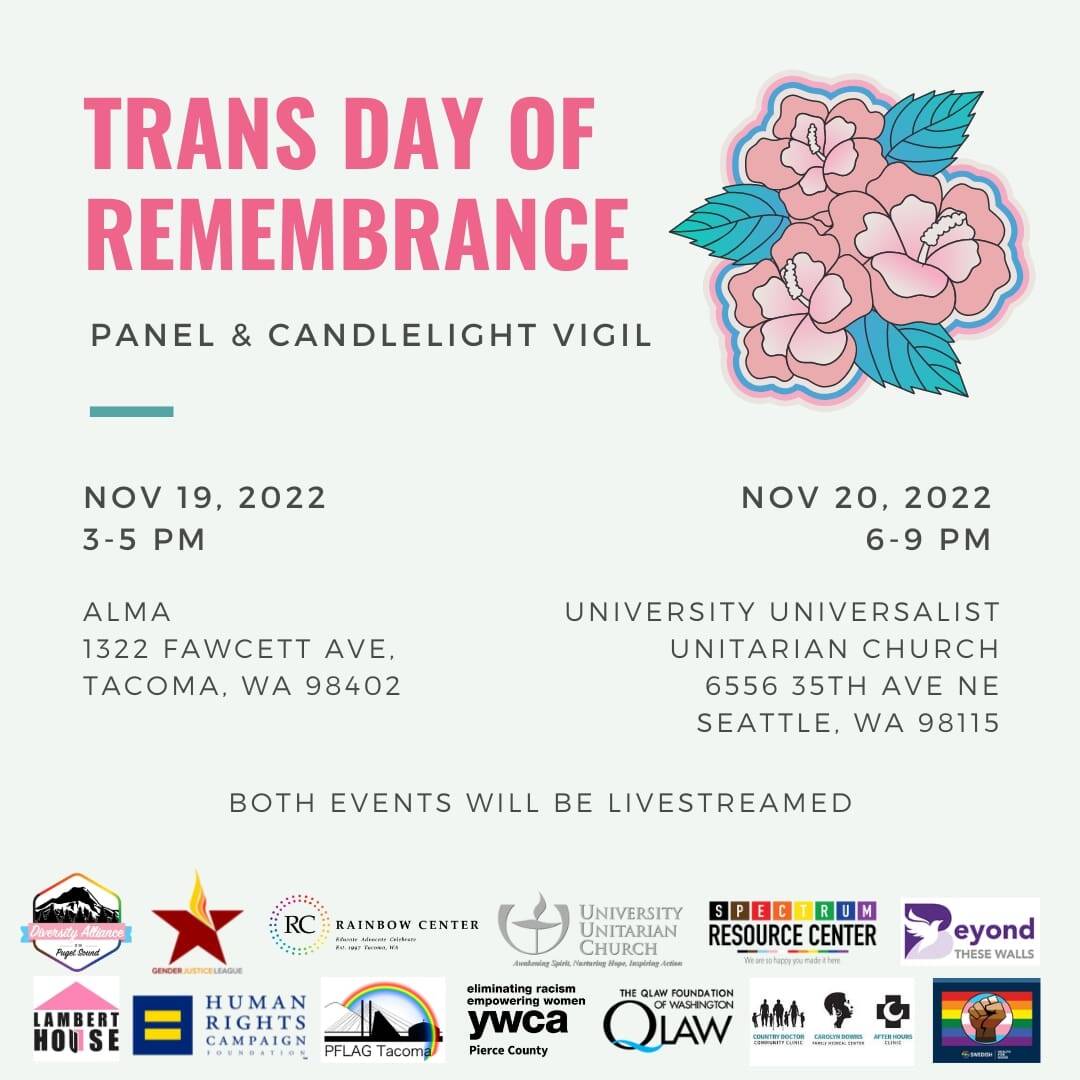
The Diversity Alliance of the Puget Sound (DAPS), which directly services the transgender and gender diverse communities in Washington state, hosts events to support these communities all year long. TDOR Tacoma returned for its 15th year, and TDOR Seattle for its 5th year. Both events consisted of panel discussions and candlelight vigils.
“I have found that change has been slow going, while community organizers, like myself, are willing to come to the table with ideas and ways to work with local government, we often find ourselves alone there,” said Oliver Webb, executive director of DAPS.
Webb explained how cities on the Eastside, among others, were asked to participate in flag raising ceremonies for TDOR following the Washington murders of trans LatinX women, Martinez and Outumuro. Webb said that cities declined for various reasons, and the majority of cities cited the lack of flag-raising policies.
Webb has seen proclamations and internal ceremonies this year, they occur without input from local organizations and transgender or gender diverse individuals.
“It is clear that our cities are not ready to do the work we need them to do, but are paying attention to the work being done in other cities that work with local organizations and are blindly mimicking them without putting in the time and effort to build community relationships in order to truly serve their LGBTQIA+ community members,” said Webb.
Webb said he hopes that local governments will use their diversity, equity and inclusion teams for “something more than a scapegoat for fielding meeting requests” and to give their community members a seat at the table.
Causes beyond hate
While Black transgender women comprise 66% of all victims of fatal violence against the trans community, according to HRC, systemic issues have an impact.
The dehumanization of transgender people begins with anti-trans stigma, which can look like the lack of family acceptance, a hostile political climate, cultural marginalization and invisibility. HRC also acknowledges how the denial of opportunities plays a role in fatal violence, such as setbacks in education, employment discrimination, barriers to legal identification, exclusion from healthcare and social services, unequal policing and criminal justice system, and barriers for immigrant refugees and asylum seekers.
Increased risk factors reinforce stigma and false narratives about transgender people, such as engagement in survival sex work, poverty and houselessness, and physical and mental health disparities.
Interpersonal violence accounts for a significant number of fatalities. In 2021, about 7 in 10 transgender and gender nonconforming people who were killed as a result of fatal violence were killed by an acquaintance, friend, family member or intimate partner, according to HRC. For victims fatal violence in 2013-2021:
- 36% were killed by an acquaintance.
- 24% had no known relationship to their killer.
- 21% were killed by an intimate partner
- 10% were killed by a family member or close friend.
- 6% were killed by police or the federal government.
Since 2013, at least 84% of violence against the transgender community has involved people of color. Most victims of fatal violence against transgender people are under age 35:
- Under 18 years: 4%
- 18-35 years: 71%
- 36-50 years: 16%
- 51+ years: 6%
- Unknown age: 3%
Talk to us
Please share your story tips by emailing editor@kentreporter.com.
To share your opinion for publication, submit a letter through our website https://www.kentreporter.com/submit-letter/. Include your name, address and daytime phone number. (We’ll only publish your name and hometown.) Please keep letters to 300 words or less.