
An earthquake isn’t an equal-opportunity shaker.
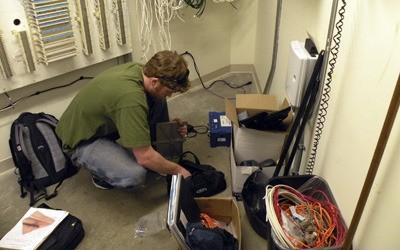
So to determine how a quake’s power differs across the Puget Sound region, scientists are setting up sensitive monitoring equipment in someplace solid, such as a house basement, to track that power as part of the NetQuakes project.
A handful of seismographs have been installed in Renton and Kent, where soils, topography and the ground rupture itself all play a role in how a quake affects buildings.
“We discovered in the Nisqually quake and other quakes around the world that ground motion can vary pretty dramatically from neighborhood to neighborhood,” said Bill Steele, Seismology Lab coordinator for the Pacific Northwest Seismograph Network.
Monitoring of the State Route 167 corridor has been emphasized, because of a lack of monitoring stations to track ground motion, he said.
There were some ground-motion stations in 2001 that monitored the Nisqually quake, but not in Renton and Kent, he said. In that quake, a production building at the Boeing plant in Renton was red-tagged, he said. But scientists didn’t have a direct measurement of the ground motion there.
 “We want to begin filling in so that doesn’t happen again,” he said.
The network, run out of the UW Seismology Lab, is looking for volunteers in the Auburn area, where there are currently no NetQuakes seismographs.
The equipment uses a wireless router to send the measurements to a U.S. Geological Survey facility in California, then almost immediately to the UW lab in Seattle. The USGS oversees the NetQuakes program nationally and provides the equipment.
Ideally, scientists would like one of the strong-motion monitors every kilometer or roughly every two-thirds of a mile in the urban Puget Sound region. A national plan calls for 600 strong-motion monitors in then Puget Sound region; right now there are about 100.
“We have a long ways to go,” Steele said. Each year the network is allocated a certain number of seismographs.
NetQuakes continues to look for volunteers to host the small monitoring equipment, which is anchored to something solid in a house or business.
“The idea is to involve citizens in the science,” he said.
Interest in the science is what drew Sarah Markham of Renton to volunteer to host one of a seismograph in the basement of her north Renton home.
“I could do that,” she said, after learning about the program.
Her home is not far from Lake W
ashington and Boeing’s Renton production plant. Her location helps fill in the gap that Steele mentioned near the Boeing plant.
The wireless router that sends data to the USGS sits in her living room. The blue seismograph is anchored to the basement floor next to the furnace in her home, built in 1920.
Markham is a fairly recent resident of Renton. Her family has deep roots in Illwaco, on the Washington coast. There the concern was a tsunami from the Pacific. She has never experienced an earthquake.
In 1986, her family fled to higher ground after an Alaska quake triggered a tsunami warning across the Pacific.
Several factors are considered in locating a seismograph. Ideally, it’s a single-family dwelling with a concrete slab lying directly on the ground and not a deep basement.
The geographic location is important, including the floor of a valley or a ridge, so scientists can understand the impact of a quake on different structures, he said.
“We can’t predict earthquakes,” Steele said, but the network of seismographs had help scientists better understand the effects of a quake.
BEFORE AN EARTHQUAKE
- Repair defective electrical wiring, leaky gas lines, and inflexible utility connections. Get appropriate professional help. Do not work with gas or electrical lines yourself.
- Bolt down and secure to the wall studs your water heater, refrigerator, furnace, and gas appliances. If recommended by your gas company, have an automatic gas shut-off valve installed that is triggered by strong vibrations.
- Place large or heavy objects on lower shelves. Fasten shelves, mirrors, and large picture frames to walls. Brace high and top-heavy objects.
- Store bottled foods, glass, china and other breakables on low shelves or in cabinets that fasten shut.
- Anchor overhead lighting fixtures.
- Be sure the residence is firmly anchored to its foundation.
- Install flexible pipe fittings to avoid gas or water leaks. Flexible fittings are more resistant to breakage.
- Hold earthquake drills with your family members: Drop, cover, and hold on!
- Locate safe spots in each room under a sturdy table or against an inside wall. Reinforce this information by moving to these places during each drill.
DURING AN EARTHQUAKE
- Minimize your movements during an earthquake to a few steps to a nearby safe place. Stay indoors until the shaking has stopped and you are sure exiting is safe.
- If indoors, take cover under a sturdy desk, table, or bench or against an inside wall, and hold on. If there isnÕt a table or desk near you, cover your face and head with your arms and crouch in an inside corner of the building. Stay away from glass, windows, outside doors and walls, and anything that could fall, such as lighting fixtures or furniture.
- If in bed when the quake strikes, stay there, hold on and protect your head with a pillow, unless you are under a heavy light fixture that could fall. In that case, move to the nearest safe place.
- Use a doorway for shelter only if it is in close proximity to you and if you know it is a strongly supported, load-bearing doorway.
- If outdoors, stay there. Move away from buildings, streetlights, and utility wires.
- In a moving vehicle stop as quickly as safety permits and stay in the vehicle. Avoid stopping near or under buildings, trees, overpasses, and utility wires.
AFTER AN EARTHQUAKE
- Be prepared for aftershocks. These secondary shockwaves are usually less violent than the main quake but can be strong enough to do additional damage to weakened structures.
- Open cabinets cautiously. Beware of objects that can fall off shelves.
- Stay away from damaged areas unless your assistance has been specifically requested by police, fire, or relief organizations.
- Be aware of possible tsunamis if you live in coastal areas. Stay away from the beach.
- Inland tsunamis, called seches, are possible in land-locked bodies of water.
Where to volunteer
The NetQuakes project is operated in the Northwest by the Pacific Northwest Seismic Network at the University of Washington Seismology Lab. The network is taking applications for volunteers to host a seismograph, especially in the Auburn. Information about NetQuakes and volunteering is available at the U.S. Geological Service website.
Talk to us
Please share your story tips by emailing editor@kentreporter.com.
To share your opinion for publication, submit a letter through our website https://www.kentreporter.com/submit-letter/. Include your name, address and daytime phone number. (We’ll only publish your name and hometown.) Please keep letters to 300 words or less.