
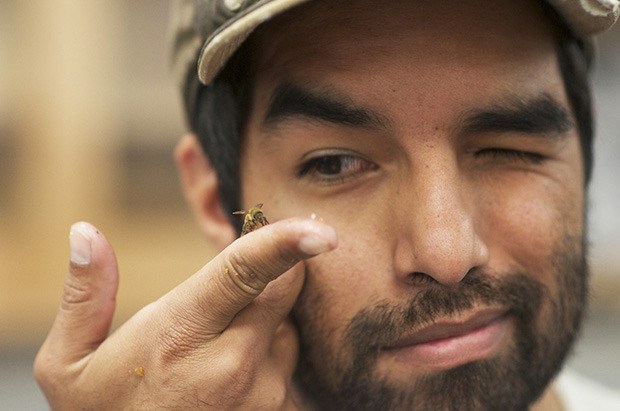
Bee stings don’t really hurt Danny Najera like they used to.
After years of studying the creatures — including accidentally dropping a hive while carrying it in the middle of the night — he’s come to accept them as simply an occupational hazard.
Now Najera is bringing his enthusiasm for the insects to Green River, where he uses the bees as way to not only show the complexity of life, but to illustrate how ecosystems are interconnected.
“There is a direct connection between the health of bees and the health of our agricultural system,” he said. “Do you like apples? Yeah. Then you like bees. Do you like strawberries? Yes. Then you like bees.”
Najera, a Ph.D from the University of Kansas who lives in Kent, has brought in his own bee colonies to illustrate the complexity and interconnectedness of the environment to his biology students at Green River Community College. “There has been no other organism that I can carry around in a box and get anything near as much as a powerful lesson as these honeybees.”
The boxes he refers to are his colony demonstrations, two plywood boxes two with hinged shutters covering Plexiglas for observing the bees. They serve as Najera’s live instructional displays.
The bees produce an audible buzzing despite the Plexiglas wall, but the sound pales in comparison to the tactile vibrations that hundreds of insects give off. Touching the plastic barrier feels like touching a low power massage ball.
Najera developed an interest in biology while living in Washington and attending Green River and followed that passion through his schooling when his family moved to Kansas.
“I got the fascination with bees at University of Kansas,” he said, “but generally the fascination with life, and why I’m a biologist, came from the Pacific Northwest.”
Najera’s lessons at Green River help to impart some of the knowledge developed by Austrian zoologist Karl Von Frisch, specifically his 570-page tome that examines bee communication, to his students. The educator developed his interest in bees while studying at the University of Kansas under Von Frisch’s pupil Rudolf Jander, who taught a class on animal cognition.
“We got to see how complex they were, and it just blew my mind,” Najera said.
Bee ‘dances’
To illustrate this complexity, Najera walks his students through how a bee “dances” to alert other bees to the location of food.
While Aristotle, observing the bees thousands of years before, believed that these motions were simply done because the bee was happy it found food, Najera says that it’s part of a complex and hard-wired method of communication within the colony.
When a worker bee discovers a source of pollen, it returns to the hive and shakes it’s thorax while revolving clockwise. Each shake provides direction, and each revolution an indication of distance. By repeating this dance, the bee can give fellow workers the distance and direction of food to within a meter of precision.
The complexity of bees can’t be overemphasized, says Najera. If a bee travels to a food source and finds it depleted, it can consult a built in map of the . This information is all hard-encoded to the bee’s brain almost like a computer, says Najera.
Narjera says that learning about honeybees helps his students better understand the interconnections of plant ecology. When they’re not cross pollinating plants in an area, they’re a mild indicator of how an area is doing. Even their wax and honey absorbs pesticides and can be used for research on the chemicals.
“They’re miniature plant ecologists. They’re better plant ecologists because they don’t take the weekends off.”
When he’s not studying or teaching about bees, Najera spends time with his sons or runs and hikes outdoors. But mostly it’s the bees.
“My poor wife,” he said with a laugh. “I need a blanket for the bees, which one can I have? She’s like ‘none of them?'”
As the world becomes more ecologically minded, Najera believes that bees will become more important in our education and understanding of its systems.
“This species for me is a flagship organism to starting to curb our impact ecologically,” he said.
His hope is that by simply spending an hour learning about bees, students and visitors will be able to respect and appreciate the multifaceted aspects of nature.
Even the ones that sting us.
Talk to us
Please share your story tips by emailing editor@kentreporter.com.
To share your opinion for publication, submit a letter through our website https://www.kentreporter.com/submit-letter/. Include your name, address and daytime phone number. (We’ll only publish your name and hometown.) Please keep letters to 300 words or less.
