
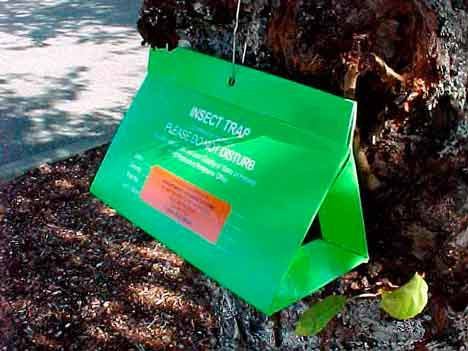
The Washington State Department of Agriculture annual gypsy moth summer trapping program is underway once again. By the end of July more than 22,000 small cardboard traps will be placed around the state, checked every two to three weeks during the summer, and taken down in September. Traps will be placed in all 39 counties.
A total of 4,000 traps will be placed in King County, the highest of any county in the state. Areas in the county that will be intensively trapped because of past gypsy moth activity are:
Port of Seattle because of the threat of Asian gypsy moths coming off foreign ships at the port
In Bellevue near the intersection of Lakemont Blvd. SE and Village Park Dr.
In Bellevue near the intersection of SE 160th Ave. SE and SE 63rd St.
In Skyway near the intersection of Renton Ave. and 74th Ave. S.
On Tiger Mountain near the intersection of Tiger Mountain Road and SE 160th St.
In Kent near the intersection of Kent-Des Moines Road S. and the West Valley Highway
Southeast of North Bend near the intersection of 468th Ave. SE and SE 146th St.
East of Sahalee near the intersection of 259th Way NE and NE 39th Way
In Federal Way near the intersection of SW 342nd St. and 30th Ave. SW
In Renton near the intersection of SW 27th St. and East Valley Highway
Washington has never had a permanent population of the gypsy moth, reportedly the worst forest pest ever brought into the U.S. Nineteen states in the East and Midwest are not so fortunate. Thousands of acres in those states are permanently infested.
The gypsy moth attacks more than 500 species of trees and plants. In its caterpillar form the pest quickly strips trees and plants of leaves, destroying some and weakening others so they are susceptible to plant diseases. The caterpillar also destroys wildlife habitat, degrades water quality and triggers costly quarantines of timber, agriculture, and nursery products.
Washington’s last eradication treatment project took place in 2007 in Kent.
Tracy Shirek, trapping coordinator for King County, is looking forward to the coming trapping season. “We’ve kept this pest out of the state for 36 years,” she said. “We want that record to continue.”
The number of gypsy moths caught annually in Washington varies widely. The largest number caught was 1,315 in 1983, and the smallest number in the last 30 years was 17 in 2002. Last year 18 moths were caught. For more information on Washington’s gypsy moth control program, call the gypsy moth hotline at (800) 443-6684 or visit the agency’s website at http://www.agr.wa.gov/PlantsInsects/InsectPests/GypsyMoth.
Talk to us
Please share your story tips by emailing editor@kentreporter.com.
To share your opinion for publication, submit a letter through our website https://www.kentreporter.com/submit-letter/. Include your name, address and daytime phone number. (We’ll only publish your name and hometown.) Please keep letters to 300 words or less.
