County leaders, residents sound off on race, law enforcement | Can Ferguson happen here?
Published 4:22 pm Thursday, September 11, 2014
It’s hard talk, a sensitive conversation and one King County and community leaders welcome.
A public forum to openly discuss county law enforcement’s relationship with diverse neighborhoods it serves jammed a Tyee High School cafeteria in SeaTac on Wednesday night.
The topic? Can Ferguson, Missouri happen here?
Residents of surrounding cities say Ferguson is here. Law enforcement authorities acknowledge that it could happen. And both sides are calling for ways to debate, build and improve working ties between police and ethnic communities.
Several citizens took turns voicing their concerns, fears and objections to how the King County Sheriff’s Office approaches its work, especially now, in wake of Michael Brown’s death.
Brown, an unarmed African-American teenager, was shot to death by Darren Wilson, a white police officer, in the streets of Ferguson on Aug. 9, a controversial incident that has led to protests, hostilities and arrests in the St. Louis suburb.
Witness reports differ greatly as to whether Brown was surrendering with his hands up or moving toward Wilson when the final shots were fired.
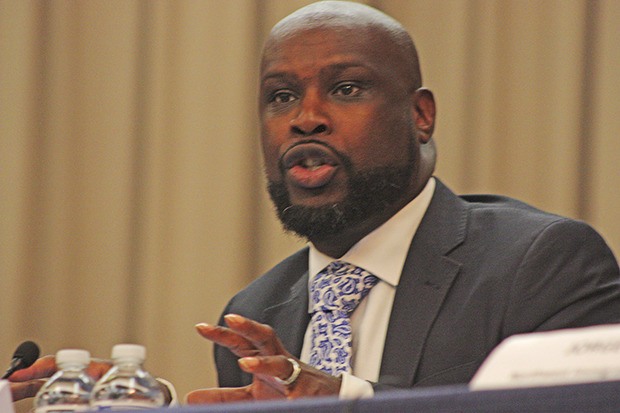
The shooting served as a backdrop for the county-led forum Wednesday that featured a panel of authorities, community advocates and agency officials – including King County Sheriff John Urquhart and King County Prosecutor Dan Satterberg – who fielded questions from the crowd.
Both sides agree that tensions exist, and something needs to be done to soothe them.
“The reality is because of Ferguson and events like Ferguson that happen all across the country, the thought is, ‘Is this the day I’m going to be shot?'” asked Dr. Edward Donalson III, an author, entrepreneur and thought coach who serves the Kingdom Family Worship Center in Kent. “Until we reestablish a connectivity between police and the community – places like churches and community centers, high schools, etc. – we’re always going to have that tension.
“… Communities are not convinced that law enforcement is in place to protect and to serve and (how it) relates to people of color.”
Residents and law enforcement leaders admit more work needs to be done to build and improve those relationships.
Darlene Anthony, of Des Moines, asked what conversations or initiatives are being taken to make law enforcement and minority communities work better together.
Willingness to talk
Urquhart said having an open discussion is an important first step.
“I’m here,” Urquhart said. “… I have to wonder, did Ferguson, Missouri ever have a community meeting like this? I doubt it. And you have to wonder, would the events in Ferguson, Missouri have happened if the police department there had listened to the community? I don’t think so. I don’t think it would have been as bad if they did.”
But Urquhart admits his department can improve in many ways, notably working to recruit, train and hire more minority deputies. Officers also need to become more visible, accessible and sensitive to the people they serve, regardless of race, he said.
“The biggest mistake, detriment to community policing … was the invention of the patrol car,” Urquhart said. “What my officers do now is drive around in their air-conditioned offices on four wheels … with their cellphones … and computers at their fingertips. They never get out. There is no way to interact with the public.
“If I had my druthers, I’d have nothing but beat cops walking the streets like we used to,” he said. “We can’t afford it. That’s why we don’t have it.”
The audience also brought up enforcement tactics, including the use of neck restraints, “choke holds” – a deadly police move that the NAACP has condemned – and concerns about a militarized police force.
“The Sheriff’s Office will no longer train on LVNR (Lateral Vascular Neck Restraint), neck restraints or choke holds,” Urquhart told the audience, reversing the controversial practice the county force had used.
Urquhart also added, “We’re not going to let the police department become militarized like Ferguson, Missouri. Simple as that.”
Body cams proposed
Body cams are also a possibility, so says King County Councilmember Dave Upthegrove, who hosted the forum. Upthegrove announced that he introduced legislation Wednesday to begin the process of equipping deputies with body cameras and to develop appropriate privacy policies for their use.
County officials also are in the process of replacing Charles Gaither, the first director of King County’s Office of Law Enforcement Oversight (OLEO), who left the job on Sept. 5 after what he describes were three “difficult” years. Gaither said it wasn’t until the Sheriff’s Office implemented a policy to reinstate LVNR training after a 10-year hiatus that he decided to leave his post.
Forthcoming changes will help, authorities said, but the reality of the situation remains – how does law enforcement handle the many issues related to race in growing, diversified communities?
“How do I deal with a Sikh cab driver who gets killed during a robbery? How do you deal with those communities when there’s language, cultural and ethnic barriers?” said Jim Graddon, recently retired SeaTac police chief who worked 34 years with the King County Sheriff’s Office and now serves on the advisory panel to OLEO.
“One of our officers was involved in a shooting the night before Ramadan was to begin in a mosque in the city of SeaTac. How do you deal with that?
“If you don’t have some element in your back pocket to help you deal with that, you are going to misstep. It’s not a matter of if you’re going to misstep.”
Gwen Allen-Carston, a Kent businesswoman and executive director of the Kent Black Action Commission, told the panel that she and others want a safe future for her growing neighborhood policed by a sensitive and fair force.
“We do have black folks coming to the South King County region and, with respect to that, we do have an expectation that we will be treated as fairly as anyone who might be living in the region,” she said.
=====
PHOTO BELOW:
King County Sheriff John Urquhart, right, with King County Prosecutor Dan Satterberg, fields questions from the crowd at Wednesday’s community forum. MARK KLAAS, Kent Reporter