King County considers sales tax increase for unincorporated road projects
Published 1:10 pm Tuesday, March 17, 2026
King County’s Road Services Division is heading for a fiscal cliff — and elected officials are exploring a potential increase in sales tax to help bridge its $200 million annual budget gap.
After running an average $200 million budget shortfall for the last several years, Roads Services estimates that it will have to eliminate its capital fund, which, in short, “… would mean that we can’t do any new projects,” Director of Roads Services Tricia Davis told the county’s Transportation Benefit District during its Feb. 25 meeting.
Davis also said that emergency response would be hindered, bridge repairs and replacements would be delayed or canceled, and grant money would disappear.
“Right now our capital improvement program is highly dependent on grant revenues, but we wouldn’t even be able to get those grants without that local funding,” she continued.
The lack of grant funds would greatly exacerbate Road Division’s financial woes, as it makes up 55% of its capital program’s budget.
At this point, the Roads Division is funded 100% through grants and King County property taxes — but the Transportation Benefit District is now exploring implementing a 0.1% increase in the county’s sales and use tax.
The Transportation Benefit District (TBD) is a special taxing district separate from the King County Council, although the same elected officials populate both, and it is chaired by Councilmember Claudia Balducci.
If approved, this would be the first time since the the TBD has exercised its taxing powers in its 12 years of existence. The sales tax increase would be expected to raise an additional $101 million in tax revenue per year — potentially halving the funding gap, but not clearing it.
The TBD discussed the possible tax increase during its Feb. 25 meeting, and a special meeting is scheduled for March 19 to continue the conversation.
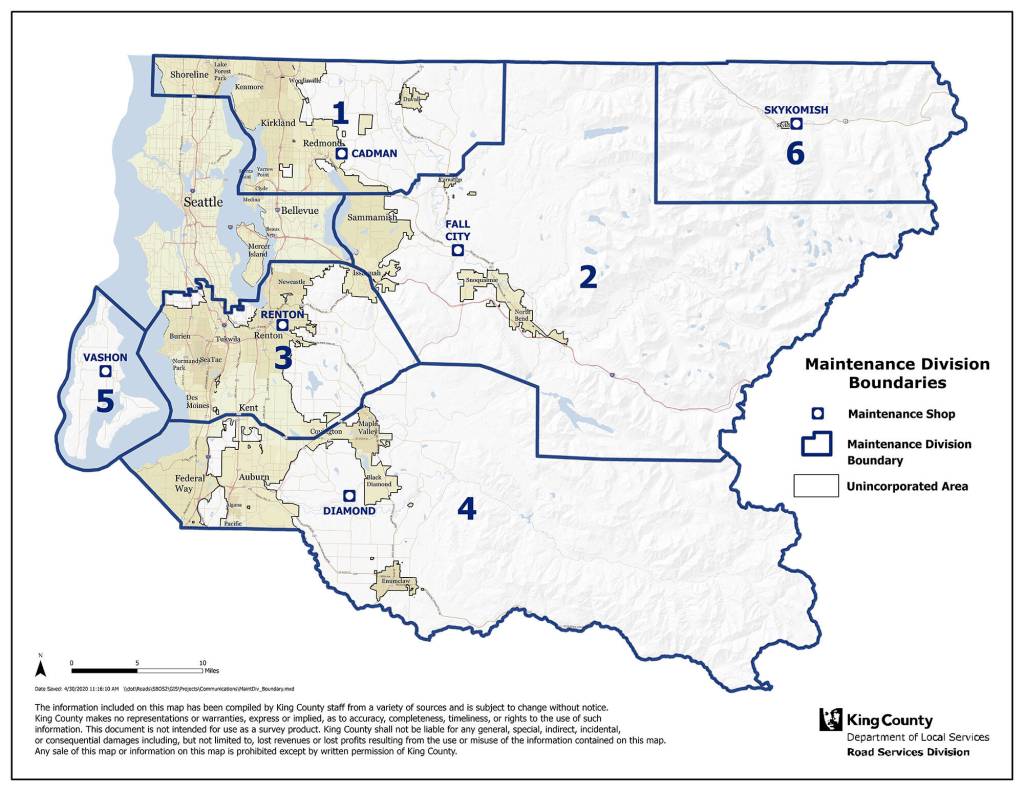
While an increase in the sales tax will affect everyone in King County, Roads is specifically tasked with addressing issues with and improving transportation in unincorporated areas like outside Enumclaw and Black Diamond. Roads Division’s Diamond and Renton sections, which encompasses all of South King County and up toward Newcastle and Bellevue, contains a large swath of all the roads it is responsible for.
Some examples of local projects funded through the Roads Division include replacing the Boise X Connection Bridge south of Enumclaw and resurfacing 400th Street north of Enumclaw, both of which are expected to begin this spring or summer.
ROADS: AN OVERVIEW
King County’s Road Services works on more than 1,500 miles of road in unincorporated King County, which Davis said would stretch out further than the Mexican border to Canada, if laid out straight.
About 250,000 people live in unincorporated King County, but more than one million trips are made on those roads every day, mostly people going from city to city.
“We really notice, if you live in Issaquah… Maple Valley, or Black Diamond, you are dependent on this unincorporated road to get from place to place, and people really notice our unincorporated roads which connect to cities,” Davis said.
And it’s not just roads. The Roads Division also cares for the lines, signs, and sidewalks that come with them — along with nearly 4.8 million feet of drainage ditches, 3.5 million feet of drainage pipes, and 28,000 to 29,000 catch basins and culverts.
The Roads Division operates with a $129 million budget and a $25 million capital programs budget, bringing its total budget to about $154 million.
HIGH DEMAND, LOW FUNDS
King County Council staff member Nick Bowman presented to the TBD several reasons why the Roads Division is facing a grim financial situation.
One of the biggest reasons, Bowman said, is because of Washington’s tax structure. Its gas tax revenue has been flat for years, and property tax revenue increases are limited to 1% per year.
Meanwhile, the county’s population continues to grow, from 1.8 million people in 2006 to nearly 2.4 million in 2024.
“As we see regional growth happening in cities, we don’t see the funding that is able to support that infrastructure that connects the cities,” Davis said. “We see increasing demand for service without the ability to keep up with that.”
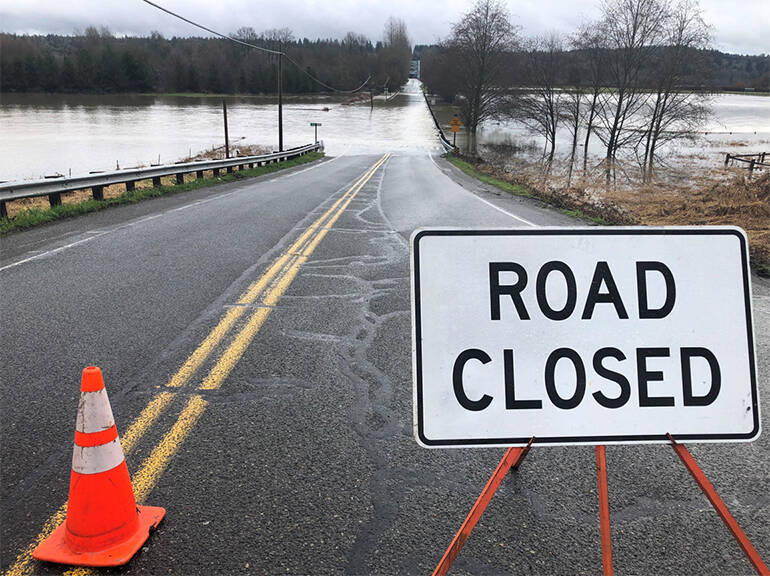
Last December’s flooding event also affected the Roads Division. It’s estimated the floods caused more than $10 million in damage, and reimbursement from the Federal Emergency Management Agency is not certain, Davis said.
“Without additional funding, the County remains vulnerable to future storm, snow, or seismic events,” she said.
Even if the TBD approves a 0.1% increase in sales tax for county’s Roads Division, the estimated collections would only cover half the department’s annual budget shortfall.
Another way the council can address the shortfall is to go to the voters with a proposal to increase the sales tax by 0.2%. It’s estimated this would result in an additional $200 million in collections per year.
This could stack on top of the TBD’s 0.1% sales increase.
Another potential solution would be to increase vehicle license fees — the TBD can implement up to a $50 fee without voter approval, or voters can approve up to a $100 fee.
Tax revenue estimates come in at $15.5 million for every $10 in vehicle license fees, so a full $50 fee could bring in upward of $77.5 million.