Memorial Day at Mt. Rainier: ‘The Flight Has Ended, They Are Now In Thy Keeping’
Published 12:19 pm Tuesday, May 19, 2026
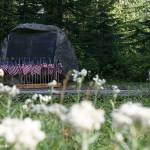
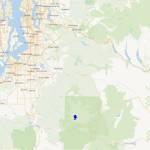
This Memorial Day weekend, consider making a trip to the southeast side of Mt. Rainier National Park, where, over a year after the end of World War II, 32 United States Marines lost their lives after their plane crashed into the South Tahoma Glacier of Mt. Rainier.
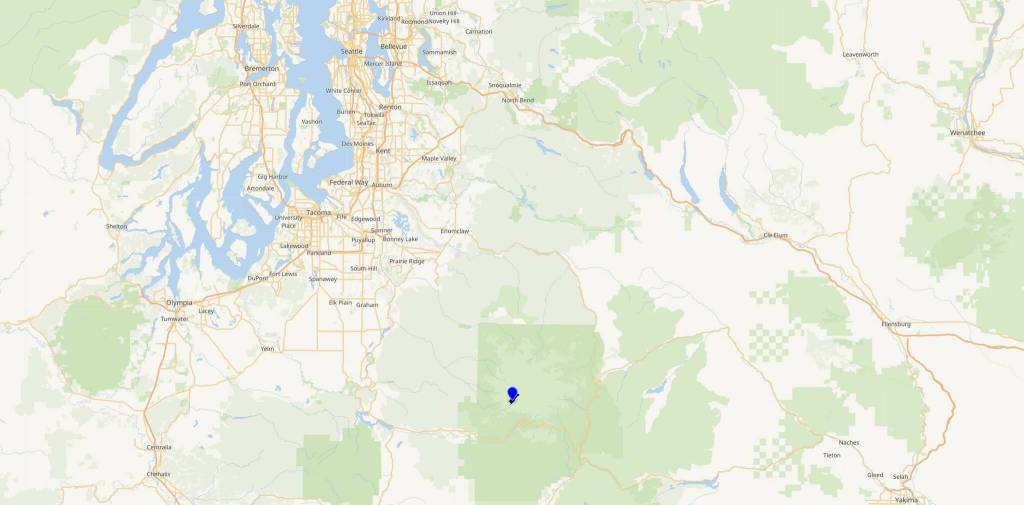
80 years later, the plane and the military men still remain on the mountain, and there is a memorial dedicated to them near the Lake George and Gobblers Knob Trailhead, past Ashford, Washington.
It was the morning of Dec. 10, 1946, when a United States Marine Corps (USMC) Curtiss Commando (C-46/R5C) transport plane was flying from San Diego to Seattle with six other planes. They were headed to Naval Air Station Seattle, which was located at Sand Point on the west side of Lake Washington.
But when the convoy of aircrafts entered southwest Washington, the weather proved to be heavy and precarious.
Four of the planes turned around to land in Portland, while two planes pushed on. One plane was able to safely land in Seattle, but the plane that was crewed by pilot Major Robert V. Reilly, copilot Lieutenant Colonel Alben C. Robertson and crew chief Master Sergeant Wallace J. Slonina was about to head off track.
According to Flying magazine, it was 4:12 p.m. – minutes before the sun was due to set – that Maj. Reilly had made his final call to the Civil Aeronautic Administration (CAA), saying that the weather conditions were so bad that he and his crew could not visually see where they were going — and that they were relying on instrument flight rules (IFR), or instruments, to fly. Flying magazine says that in 1946, these instruments were in their infancy.
Maj. Reilly told CAA that ice was forming on the leading edges of the plane’s wings and requested permission to fly above the storm.
The plane had been flying steadily at 9,000 feet for the bulk of the trip, but somewhere in that storm was Mt. Rainier, a sleeping behemoth standing at 14,410 feet.
After the crew had failed to radio their new altitude and the plane could not be reached, a search-and-rescue team was wrangled up, but the bad weather persisted, keeping Army, Navy and Coast Guard search planes grounded and effete.
Locals had reported hearing airplane engines around that time when the plane disappeared ,and Mt. Rainier National Park rangers had heard a plane flying near Longmire and Paradise a few minutes after Maj. Reilly’s last call. According to David C. McClary of HistoryLink.org, it was thought that the plane had crashed into the Nisqually Glacier, which is located over 2.5 miles east of the South Tahoma Glacier.
Attempts were made over several days for park rangers to scale Panorama Ridge and scout for the plane, but blizzards, low visibility and reports of avalanches meant that it was possible that the plane would never be seen again. One newspaper at the time said that “the worst storm conditions in a decade stymied search parties” with a subheadline that read “Hope for Safety Of 32 Marines Wanes.”
The weather finally cleared almost a week later on Dec. 16, 1946, allowing 25 military planes to search along the slopes of Mt. Rainier and along the missing plane’s projected path near Toledo. Despite their best efforts, no trace of the plane could be found. After two weeks, the search had been called off for the season, allowing officials to investigate the disappearance while they waited for summer.
The investigation painted a better idea of what had happened leading up to the crash. The Navy concluded that the plane was flying 180 mph when it had crashed into a glacier on the south or southwest side of Mt. Rainier after an undetected wind shift had knocked the plane off course and toward the mountain. It was July 21, 1947, when Assistant Chief Ranger Bill Butler spotted plane wreckage high up on the treacherous South Tahoma Glacier.
Over the next month, search teams were able to recover small items like a Marine Corps health record, a seatbelt and parts of the fuselage, but it was not until Aug. 18 that Butler spotted the crushed nose of the plane at the 10,500-foot level of the glacier, and the search team found that the bodies of 11 men were inside, which was reported on by the Seattle Post-Intelligencer. On Aug. 22, mountaineers discovered that 14 more bodies were wedged in a crevasse, along with more pieces of the plane. Most of the bodies were encased in ice.
Two days later, over 200 people attended a memorial service on a knoll at the 4,000-foot summit of Round Pass, near Longmire. A few days after the service, military and National Park officials concluded that the mission to recover the bodies of the 32 Marines would endanger the lives of the recovery teams. It was decided that all recovery attempts would cease, especially after the Seattle Post-Intelligencer’s publication of a letter from the parents of six of the Marines asked “that all activity be abandoned, leaving our sons in the care of our Creator.”
The family members that had attended the Aug. 24, 1947, service at Round Pass decided that they would return each August to hold a memorial in honor of the marines.
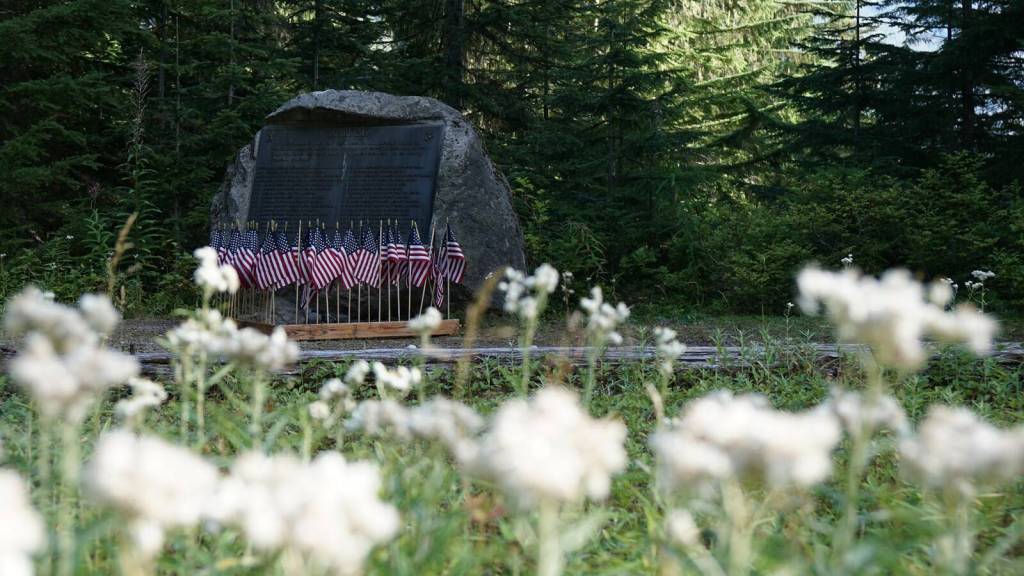
A large boulder with a bronze plaque, called Marine Memorial, was erected to the east of Round Pass, which the families returned to for decades. But in the mid-1990s, the road was washed away and the memorial initially only became accessible for hikers.
According to the National Park Service, from May to November, vehicles can now travel three miles up Westside Road and attempt to park at Dry Creek, which has limited parking space. From there, hikers or bikers can make the 3.8 mile trek to the Marine Memorial. While summer is the best time to visit, it is possible to visit in the winter if you use snowshoes or cross-country skis to get past the closed road signs.
For those in want or need of a more accessible option, a replica of the granite memorial was installed in 1999 at the Veterans Memorial Park in Enumclaw. Both memorials bear the words “The Flight Has Ended, They Are Now In Thy Keeping,” and the names of all 32 marines, including the 29 passengers:
Master Sgt. Charles F. Criswell
Private Duane R. Abbott
Pvt Robert A. Anderson
Pvt Joe E. Bainter
Pvt Leslie R. Simmons Jr.
Pvt Harry K. Skinner
Pvt Lawrence E. Smith
Pvt Buddy E. Snelling
Pvt Bobby J. Stafford
Pvt William D. St. Clair
Pvt Walter J. Stewart
Pvt John C. Stone
Pvt Albert H. Stubblefield
Pvt William R. Sullivan
Pvt Chester E. Taube
Pvt Harry L. Thompson Jr.
Pvt Duane S. Thornton
Pvt Keith K. Tisch
Pvt Eldon D. Todd
Pvt Richard P. Trego
Pvt Charles W. Truby
Pvt Harry R. Turner
Pvt Ernesto R. Valdovin
Pvt Gene L. Vremsak
Pvt William E. Wadden
Pvt Donald J. Walker
Pvt Gilbert E. Watkins
Pvt Duane E. White
Pvt Louis A. Whitten.
Pvt. Simmons was from Kalama, Washington, while Pvt. Walker was from Hoquiam, Washington.
Learn more
Be it Memorial Day weekend, the end of August or even Dec. 10 of this year, consider visiting Marine Memorial (the original or its replica) and paying respects to the 32 marines who lost their lives on Mt. Rainier 80 years ago.
To learn more about Marine Memorial, visit nps.gov/places/marine-memorial.htm.